
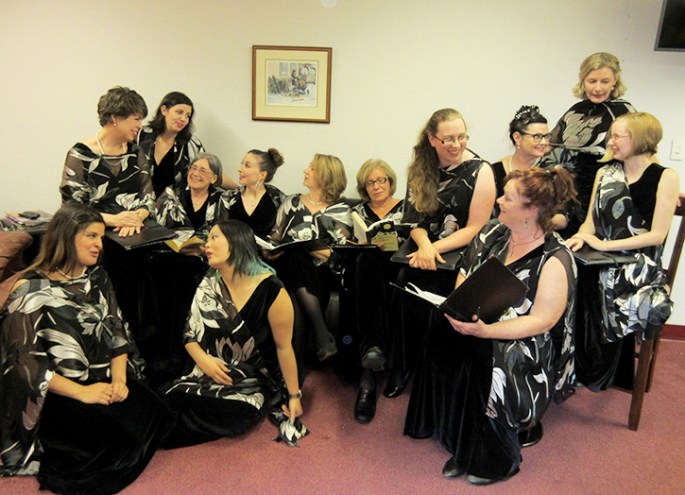
Elektra Women's Choir

Concert Review: Choir Gives An ‘Elektra-fying’ Finale

Elektra Women's Choir
Members of the Elektra Women’s Choir relax in the green room at the Performing Arts Centre before their concert Saturday, May 23.— Image Credit: Submitted

Review by Christine Pilgrim – Vernon Morning Star

The volunteer Vancouver-based women’s choir, Elektra, led by Morna Edmundson, closed the North Okanagan Community Concert Association’s season Saturday, May 23 with professional polish and aplomb.

They were joined for their final piece, David MacIntyre’s Ave Maria, by Ancora, an Armstrong women’s choir led by Terry Logan. Together, they sang a well-earned encore from the auditorium aisles before filing into the lobby to mingle with the audience, thus providing an opportunity to discuss favourite pieces.

Mine was Jerusalem, a traditional Irish folk song arranged by Michael McGlynn, which Elektra also sang from the auditorium aisles. Choir member Grace Groot (first alto) allowed me to peep at her “dots” (a less elevated term for musical manuscript). They showed the song’s haunting, cacophonous refrain inscribed as a round, where singers could join in at whatever point and in whatever rhythm they chose. The sound of anguished yearning that resulted from this random beginning and ending left the audience hushed in a state of awe.

Soloists Danica Kell, Holly Kennedy, Malaika Horswill and Stephanie Schollen were equally effective. Meanwhile, Morna Edmundson stood silently still, listening; a solitary figure on stage, both hands folded before her. She only raised them to conduct the opening of the refrain: “Jerusalem, our happy home, when shall we come to thee? When shall our sorrows have an end?” Elektra-fying!

My second favourite was another traditional song, Russian this time, entitled Ne po pogrebu Bochonochek Kataetsja. Arranged by Kitka, it made an imaginative vehicle for the choristers’ arrival on stage. Instead of dribbling on as is often the case when risers have to be negotiated, they flowed in separate sections and took circuitous routes to arrive at interesting groupings. Their singing was faultless, with pure harmonies and sonorous tones. The marriage between soloists, chorus and percussion in this playful love song bewitched and elevated the spirit.

Da Pacem (Peace) was beautiful too. So was Northern Lights (aurora borealis, which inspired young Norwegian composer Ola Gjeilo to set to music the Pulchra es amica mea text from the Song of Solomon).  Like Da Pacem, it was sung in Latin. An English translation, along with words to every song performed, could be found in the extensive program notes.

A must-mention: when Edmundson called for the house lights to be turned up, they didn’t shine quite brightly enough for everyone to see the finely printed program, contrary to the opinion of someone presumably blessed with 20:49 vision. After a brief word with a helpful usher at intermission, the lights were adjusted to rectify the situation. Bouquets to both usher and lighting technician!

The evening’s favourites also included the curtain raiser, played masterfully by 16-year-old Jaeden Izik-Dzurko. Chopin would surely have delighted in this accomplished young pianist’s interpretation of his Barcarolle Opus 60.

The only male on stage with the 45 female choristers, Dr. Stephen Smith, also deserved applause for his impeccable accompaniment on piano and percussion.

But the last word must remain with those choristers. I confess to a prejudice in favour of the resonant tones of the male voice but their absence paled to insignificance once Elektra began to sing. As NOCCA president Paul Maynes noted, the glory of the human voice raised in song is unmatched. I’d add: of either gender.

The Morning Star contributor Christine Pilgrim reviews the NOCCA concert season.

Alysha Black plays Bruch's Violin Concerto in D Minor

Concert Review: Bergmann Duo show that four hands are better than two

Alysha Black plays Bruch's Violin Concerto in D Minor
Alysha Black plays Bruch’s Violin Concerto in D Minor before the North Okanagan Community Concert Association’s presentation of the Bergmann Duo, at the Performing Arts Centre.
— image credit: Christine Pilgrim

By Christine Pilgrim – Vernon Morning Star

Sixty years ago, it was common to see a piano in a living room, with a stash of music nearby.

Many of us stumbled through that music while others became more proficient and some even experienced the thrill of finishing on the same beat in a duet. But none, save perhaps a precious few, could even come close to the skill with which Elizabeth and Marcel Bergmann (of the Bergmann Duo) entertained at the North Okanagan Community Concert Association’s penultimate concert of the 2014/15 season.

The precision, proficiency and unity with which they played contrasted sharply with their easy style and sense of competitive fun when they introduced the pieces.

A case in point was their introduction to the fifth of Maurice Ravel’s fairytale tunes written for his friends’ children in his Mother Goose Suite (Ma Mere l’Oye). It was entitled Conversations of Beauty and the Beast.

“I’ll play Beauty; you can be the Beast,” said Elizabeth to her husband as he picked up her translation from the French text that accompanied the tune.

When the Beast (Marcel) protested his love for Beauty (Elizabeth) she suggested in true wifely fashion that he could show more feeling. Both then proceeded to do exactly that on NOCCA’s celebrated, soon-to-retire Steinway grand.

Friday’s program opened with Variations on a Theme of Robert Schumann Opus 23. Johannes Brahms wrote them after Schumann’s attempted suicide and subsequent insistence that he be admitted to an asylum near the family’s Dusseldorf home. The variations’ haunting sadness reflects Brahms’ feelings of loss and admiration for his friend and mentor. And the Bergmanns’ sensitive interpretation paid tribute to both great composers.

There followed four of six little pieces (Six Morceaux Opus 11) by Sergei Rachmaninoff.  The Bergmanns didn’t include Chanson Russe, based on an obscure Russian folk song, nor Romance, which might have been too cloying for these light-hearted lovers. But the remaining four compensated royally, with Barcarolle in G Minor. (Its rich, mysterious tones reminded its publisher of “a gondolier navigating Venetian canals beneath a moonlit sky.”)  A sprightly Scherzo led to an intense Valse that provoked the duo to sway in rhythm as their hands flew over the keys and flicked through the pages of music. The Morceaux ended with the monumentally majestic Slava.

The Bergmann Duo did equal justice to Czech composer Erwin Schulhoff’s two “morceaux” from his Dadaesque Ironien Opus 34.  Schulhoff was one of the first Europeans to weave jazz into classical music but his place in musical history was cut short by his untimely death in Wultzburg Concentration Camp in the 1940s.

The program ended with Henry Levine’s arrangement of George Gershwin’s Rhapsody in Blue, which brought the house down… and up, in an inevitable standing ovation.

The Bergmanns’ virtuosity shone again in their encore, when they tangoed on both keyboard and piano stool in perfect time, tune and harmony. That tango, once described as “a vertical expression of a horizontal intent,” left no more to be said except that this month’s curtain raiser, Max Bruch’s Concerto in D Minor, was beautifully performed by local violinist Alysha Black, accompanied by Arnold Draper.

A slightly shaky beginning did not diminish the depth of feeling with which this gifted young musician interpreted Bruch’s intricate work.

It’s no wonder the B.C. Touring Council nominated NOCCA as presenter of the year. Its final concert this season features the Elektra Women’s Choir at the Vernon Performing Arts Centre May 23, 2015.

Freelance writer Christine Pilgrim reviews NOCCA’s concert season for the Vernon Morning Star.

montreal guitar trio

Concert Review: Montréal Musketeers Have Spirit

G3 - Montreal Guitare Trio
Glenn Lévesque (left), Marc Morin and Sébastien Dufour relax before their concert at the Vernon Performing Arts Centre.
— image credit: Christine Pilgrim

by  Christine Pilgrim – Vernon Morning Star
Published: April 30, 2014

A common spirit connects three French Canadian musical musketeers known on their six CDs as the Montréal Guitare Trio.

The sum of their 30 fingers plucking, strumming, drumming and stroking their guitars, created by luthier Bruno Boutin, amounted to a triumphant close of the North Okanagan Community Concert Association’s diamond jubilee déjà vu series. Their individual names are Sébastien Dufour, Marc Morin and Glenn Lévesque, but they play as one … all for one; one for all!

I confess to a bias in favour of anyone who hails from Montréal. So the mere name, Montréal Guitare Trio (MG3), would swathe these musicians in accolades whether they were brilliant or not.

But brilliant they were; and Friday’s two-hour performance flew as fast as their fingers over the strings and frets. They had the audience on friendly first name terms as soon as they’d ended their perfectly synchronised opening arrangement of Ennio Morricone’s El Paso.

The atmosphere was jovial and the pace upbeat, even when Sébastien (Séb) took time out to untangle Glenn’s mandolin strap from the lead of his new ear pieces which replace regular feedback monitors.

MG3 learned of them from the California Guitar Trio on their recent tour together. These devices, along with touring microphones and their “fourth musketeer,” technician Ian Vadnais, meant that the sound, also enhanced by the Performing Arts Centre’s new system, was superb.

The packed house, apparently NOCCA’s biggest and certainly its broadest for some time, bears witness to MG3’s popularity. Audience and performers fed on each other’s energy and enjoyment until the feast ended in the trio’s spectacular encore arrangement of Morricone’s The Good, the Bad and the Ugly – with Marc on accordion traditionnel, Séb on charango and Glenn on guitar while whistling without moving his lips as everyone followed the passage of an imaginary fly.

The program was perfectly balanced and the program notes provided an amusing opportunity to scan the play list for the running order and find who had written and arranged each item. All three musicians trained in classical music at the Université de Montréal and are as adept at composing and arranging as at performing. Meanwhile, their spontaneous wit knitted the program into an eclectic whole.

Their exquisite new arrangement of George Harrison’s While My Guitar Gently Weeps and their moving tribute to their late friend Nick Naffin, in a lyrical, full-bodied arrangement of his Le Renard, contrasted their passionate, flamboyant flamenco treatment of Luiz Bonfá’s Manha de Carnaval.

Original compositions by Lévesque and Dufour also graced the bill, most dramatically with Breizh Tango and Garam Marsala respectively. In the former, the raw earthiness of Brittany’s gypsies was visceral, as was the sense of the heat, the colours, and taste of the spices of India in the latter; especially when Séb flipped his guitar, laid it horizontally on his knees and drummed it like a tabla while Glenn tightened and loosened a tuning peg on his to make it whine like a sitar.

MG3 is not merely a guitar trio; it is an ensemble of first-rate performers.

These three Montréal musketeers communicate through the pores of their skin, with honesty, humour, integrity and energy from the moment they strut on stage to when they march off, tous pour un; un pour tous.

Christine Pilgrim is a freelance writer who reviews the NOCCA season for The Morning Star.

Reproduced with the kind permission of Christine Pilgrim and
Vernon Morning Star


Van Dhjango

Concert Review: Van Django Concert Adds Some Heat

Van Dhjango
Members of Van Django take to the stage at the Vernon Performing Arts Centre as part of the North Okanagan Community Concert Association’s current season.
— image credit: Christine Pilgrim

by  Christine Pilgrim – Vernon Morning Star
Published: March 26, 2014

Vancouver-based acoustic string quartet Van Django breathed fire into gypsy jazz and left the audience smokin’ at the North Okanagan Community Concert at the Performing Arts Centre.

Named in tribute to guitarist Django Reinhardt, Van Django is Vancouver’s answer to Paris’s Quintette du Hot Club de France, founded by Reinhardt and his equally inspiring violinist partner Stephane Grappelli in the 1930s.  Yet the backgrounds of the two ensembles are very different.

Grappelli spent his early years starving in an orphanage and took his first lessons from street musicians, while Van Django’s violinist Cameron Wilson was classically trained and works as much with symphonic music as with jazz.

Django Reinhardt only used his first two fingers to play because his left hand was crippled as a result of the burns he sustained when his gypsy caravan caught fire.  The tragic accident that cost him the use of his third and fourth fingers gave birth to a style now emulated by countless guitarists.  Yet Van Django’s Budge Schachte’s four fingers danced along the neck of his expressive guitar like a dandy spider on steroids.  “I’ve got them, so I might as well use them,” he smiled.

The quartet’s rhythm guitarist Finn Manniche is as accomplished as his counterpart, Reinhardt’s brother Joseph, who would step in for Django when he sometimes didn’t turn up for a gig.  But Joseph Reinhardt didn’t compose whimsical waltzes like Finn Manniche’s Waltz in the Shape of a Tree, a tune that could charm the birds off that, or indeed any tree.

The Quintette du Hot Club de France boasted a second rhythm guitarist because Django felt the need for two guitars to back him when he played solo. But Cameron Wilson’s understated, sensitive rhythm accompaniment on violin worked just as well, if not better, for Van Django.

Bassist Brent Gubbels, a younger, leaner counterpart to the Hot Club’s Louis Vola, was the only Van Django member not to have his composition included in Friday’s program. Cameron Wilson’s Tea for Three cheekily juxtaposed the notes of its namesake Tea for Two to witty effect, while Schachte named his snappy Estaban for a man in a black hat selling guitars in a TV commercial.

Speaking of television, Van Django’s arrangement of TV themes such as Spiderman and the Flintstones, interspersed with glimpses of Take Five and I’ve Got Rhythm, tickled our toes and our funny bones. And when they invited us to hum Ode to Joy in their happy jazz tribute to Beethoven, we needed no second asking.  We were at our most ecstatic when Van Django played, in every sense, with Beethoven’s 5th and 9th symphonies, along with such classics as Dvorak’s Humoresque, and their encore: Reinhardt’s arrangement of Grieg’s Norwegian Dance No. 2.

Lennon and McCartney would have revelled in their rendition of Norwegian Wood. At moments, the fab four seemed to slip into the skins and spirit of that other Fab Four.

In her review of the group’s 2007 appearance at the PAC, Lisa Talesnick quoted Vernon’s guitar maestro Neil Fraser, whom the North Okanagan Community Concert Association invited, along with several of his students, to sit in the front row once more.

So it seemed appropriate to leave the last word to him.

“I love it,” he said, “The gypsy rhythm is so infectious and direct that it gets to you right away.”  I agree.  Here’s to Van Django getting to us again and again!

The next NOCCA concert is with the Montreal Guitar Trio, Friday April 25th at 7:30pm. Tickets are available at the Ticket Seller in the Performing Arts Centre or ticketseller.ca.

Reproduced with the kind permission of Christine Pilgrim and
Vernon Morning Star


Ian Parker and Coleen Venables

Concert Review: Parker Inspires & Connects With Audience

Ian Parker and Coleen Venables
Concert pianist Ian Parker was joined by Vernon violinist Colleen Venables during the North Okanagan Community Concert Association matinée Sunday February 2nd, 2014. Image credit: Christine Pilgrim photo

by  Christine Pilgrim – Vernon Morning Star
Published: Februray 5, 2014

The stage lit up (if somewhat late on cue) with concert pianist Ian Parker’s ebullient entrance and immediate connection with a virtually full house — despite competition from the NFL Super Bowl — at the North Okanagan Community Concert Association’s only matinée in its diamond jubilee season.

Parker’s first of many anecdotes mentioned a message from his cousin Jamie Parker of Gryphon Trio fame. It read, “Call me before you start practising,” and introduced a tale of how Ian as a boy, having played “awfully” one evening for his piano teacher father, was commanded to practise the following morning at 8 a.m.

That following morning was Saturday and Ian knew his father left to teach at 6 a.m. Surely he wouldn’t notice if his son slept until 12 and started practising at 3 p.m. that afternoon … which was when Ian Parker saw his father’s note on the piano. It read, “Call me at my studio before you start practising.”

The story set a jovial tone that prevailed throughout the concert, although Parker’s relaxed approach informed as well as entertained when he spoke, and overwhelmed when he played.

He talked about the various sonatas in the program, beginning with Beethoven’s Opus 27 Nos. 1 and 2 ­ sonatas quasi una fantasia which, as the titles suggest, are improvised and fantasy-like with no theme.

“They focus on emotion and harmony rather than form,” said Parker. “Loud passages often follow soft ones, perhaps because Beethoven wanted to test his hearing which was failing at the time.”

The second sonata, quasi una fantasia, apparently dubbed Moonlight Sonata by Beethoven’s publisher, established my love of classical music as a young girl when I took piano lessons.  Strains of the mournful “stretched octave” trios in its first movement wafted through the hallways of the convent where I laboured over a mundane Grade 1 piece. I vowed then to play Moonlight Sonata myself some day, like so many before and after me. But I could never hope to achieve Parker’s prowess.

His fingers blurred when he played the faster movements, as they did throughout many allegros during the concert, yet they struck each note with precision and sensitivity.

Parker was joined by Vernon’s teenage prodigy, Colleen Venables, to play Igor Stravinsky’s Italian Suite for Violin and Piano. The Introduction, Serenata, Tarantella, Minuetto and Finale were taken from Stravinsky’s neoclassical ballet Pulcinella which the dancer Sergei Diaghilev had commissioned to be adapted from Giovanni Battista Pergolesi’s original commedia dell’arte music.

Both musicians beamed in well-deserved triumph as they struck the final chords, and the audience beamed back, very loudly.

When he introduced George Gershwin’s Rhapsody in Blue, Parker told how Gershwin had asked the Parisian, Maurice Ravel, for a lesson in orchestration as he didn’t feel adequate to the task. But when Ravel found out how much Gershwin earned in New York, he suggested Gershwin give him lessons instead. The audience needed no lesson to appreciate the brilliance of both composer and interpreter and rose to its feet when Parker brought the orchestration to life. In his words, the only sound he didn’t quite emulate was that sliding “Whaaa” from the clarinet.

Franz Liszt’s Sonata in B Minor had the same effect in the second half. “Magical!” sighed my audience neighbour, piano teacher Lucy Feldman, when Parker coaxed the final “B” from the lower register of NOCCA’s Steinway for which, incidentally, he is helping to find a replacement.

Feldman’s comment described the whole concert, played almost entirely from memory. It put a new slant on the word “awed”ience.

We’ll get a chance to enjoy an encore when Parker opens the Okanagan Symphony’s season this fall with Gershwin’s Rhapsody in Blue.

The next NOCCA concert is with the violin, bass and two guitar group “Van Dhjango”, Friday March 21st at 7:30pm. Tickets are available at the Ticket Seller in the Performing Arts Centre or ticketseller.ca.

Reproduced with the kind permission of Christine Pilgrim and
Vernon Morning Star