Ian Parker and Coleen Venables

Concert Review: Parker Inspires & Connects With Audience

Ian Parker and Coleen Venables
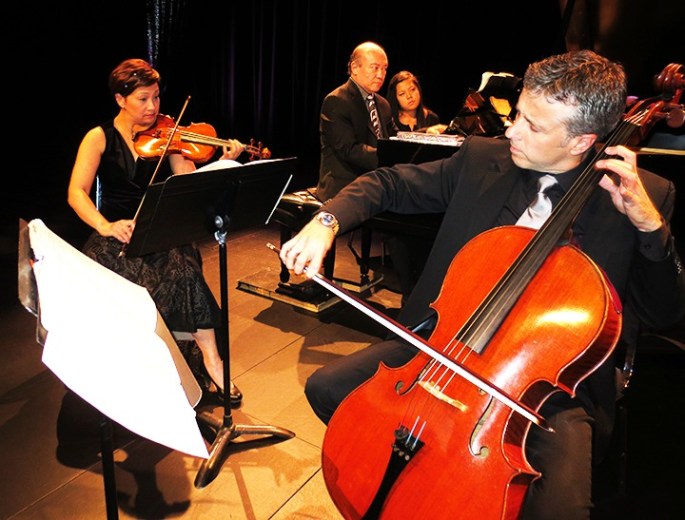
Concert pianist Ian Parker was joined by Vernon violinist Colleen Venables during the North Okanagan Community Concert Association matinée Sunday February 2nd, 2014. Image credit: Christine Pilgrim photo

by  Christine Pilgrim – Vernon Morning Star
Published: Februray 5, 2014

The stage lit up (if somewhat late on cue) with concert pianist Ian Parker’s ebullient entrance and immediate connection with a virtually full house — despite competition from the NFL Super Bowl — at the North Okanagan Community Concert Association’s only matinée in its diamond jubilee season.

Parker’s first of many anecdotes mentioned a message from his cousin Jamie Parker of Gryphon Trio fame. It read, “Call me before you start practising,” and introduced a tale of how Ian as a boy, having played “awfully” one evening for his piano teacher father, was commanded to practise the following morning at 8 a.m.

That following morning was Saturday and Ian knew his father left to teach at 6 a.m. Surely he wouldn’t notice if his son slept until 12 and started practising at 3 p.m. that afternoon … which was when Ian Parker saw his father’s note on the piano. It read, “Call me at my studio before you start practising.”

The story set a jovial tone that prevailed throughout the concert, although Parker’s relaxed approach informed as well as entertained when he spoke, and overwhelmed when he played.

He talked about the various sonatas in the program, beginning with Beethoven’s Opus 27 Nos. 1 and 2 ­ sonatas quasi una fantasia which, as the titles suggest, are improvised and fantasy-like with no theme.

“They focus on emotion and harmony rather than form,” said Parker. “Loud passages often follow soft ones, perhaps because Beethoven wanted to test his hearing which was failing at the time.”

The second sonata, quasi una fantasia, apparently dubbed Moonlight Sonata by Beethoven’s publisher, established my love of classical music as a young girl when I took piano lessons.  Strains of the mournful “stretched octave” trios in its first movement wafted through the hallways of the convent where I laboured over a mundane Grade 1 piece. I vowed then to play Moonlight Sonata myself some day, like so many before and after me. But I could never hope to achieve Parker’s prowess.

His fingers blurred when he played the faster movements, as they did throughout many allegros during the concert, yet they struck each note with precision and sensitivity.

Parker was joined by Vernon’s teenage prodigy, Colleen Venables, to play Igor Stravinsky’s Italian Suite for Violin and Piano. The Introduction, Serenata, Tarantella, Minuetto and Finale were taken from Stravinsky’s neoclassical ballet Pulcinella which the dancer Sergei Diaghilev had commissioned to be adapted from Giovanni Battista Pergolesi’s original commedia dell’arte music.

Both musicians beamed in well-deserved triumph as they struck the final chords, and the audience beamed back, very loudly.

When he introduced George Gershwin’s Rhapsody in Blue, Parker told how Gershwin had asked the Parisian, Maurice Ravel, for a lesson in orchestration as he didn’t feel adequate to the task. But when Ravel found out how much Gershwin earned in New York, he suggested Gershwin give him lessons instead. The audience needed no lesson to appreciate the brilliance of both composer and interpreter and rose to its feet when Parker brought the orchestration to life. In his words, the only sound he didn’t quite emulate was that sliding “Whaaa” from the clarinet.

Franz Liszt’s Sonata in B Minor had the same effect in the second half. “Magical!” sighed my audience neighbour, piano teacher Lucy Feldman, when Parker coaxed the final “B” from the lower register of NOCCA’s Steinway for which, incidentally, he is helping to find a replacement.

Feldman’s comment described the whole concert, played almost entirely from memory. It put a new slant on the word “awed”ience.

We’ll get a chance to enjoy an encore when Parker opens the Okanagan Symphony’s season this fall with Gershwin’s Rhapsody in Blue.

The next NOCCA concert is with the violin, bass and two guitar group “Van Dhjango”, Friday March 21st at 7:30pm. Tickets are available at the Ticket Seller in the Performing Arts Centre or ticketseller.ca.

Reproduced with the kind permission of Christine Pilgrim and
Vernon Morning Star


Reside Dawson Duo

Concert Review: Duo Gets Back To Bach

Reside Dawson Duo
Flutist Christie Reside and pianist Terence Dawson check over their music before performing for North Okanagan Community Concert-goers Friday. Image credit: Christine Pilgrim

By Christine Pilgrim – Vernon Morning Star
Published: November 27, 2013

Christie Reside and Terence Dawson, she on flute and he on piano, impressed North Okanagan Community Concert-goers at the Performing Arts Centre Friday with a palate of musical choices to suit every taste.

Bach suited mine best. As Dawson said in his introduction to Sonata for Flute in C Major, “I don’t think there’s anything like Bach.”

This particular sonata is often attributed to Bach, the father (Johann Sebastian), as a flute solo, with Bach, the son (Carl Philipp Emanuel), adding keyboard accompaniment later. To my ear, Bach by any first name would sound as sweet, and Reside and Dawson maximized the effect of the sonata’s divine form and structure to perfection.

Reside and Dawson’s rapport with each other possibly stems from their long musical partnership as well as their shared love of chamber music and desire to expand its horizons. That desire obviously influenced Friday’s program.

For example, Bach’s measured sonata was contrasted by Jacques Ibert’s syncopated sonatine, Jeux (Games), written in 1923, almost 200 years after Bach died.  Dawson warned in his introduction that occasionally “Ibert adds the odd wrong note for colour.”  And the odd wrong note in the opening phrases did add colour, while the frolicking melodies added delight to the evening.

Ibert’s compositions are as eclectic as Reside and Dawson’s repertoire and worthy of exploration.  (They range from the light-hearted Jeux to sombre orchestral pieces such as La Ballade de la Geôle de Reading, inspired by Oscar Wilde’s Ballad of Reading Gaol.)

Reside chose two sonatas by German composer Sigfrid Karg-Elert. To enhance our enjoyment of the first, she prompted us to imagine the three movements, ranging from “cheerful and lovable” to “extremely slow” to “very quick and light,” as accompaniment to a silent movie. It was easy to conjure images of Chaplin’s tramp encountering a buzzing fly that made way for a butterfly and, once their airborne pas de deux was done, to see the tramp totter into the distance. That said, the music and its sensitive execution could have stood alone.

The second Karg-Elert piece, Sonata Appassionata for solo flute, showcased Reside’s virtuoso technique. Small wonder that she’s principal flutist with both Seattle and Vancouver Symphony Orchestras.

Dawson, dubbed one of Vancouver’s most respected musicians, also shone in a solo performance of the first three of seven fantasies by Johannes Brahms.

The program opened with Lorraine Desmarais’s sonata for piano and flute, also known as Jazz Sonata. Montreal’s Desmarais is an outstanding jazz pianist as well as a composer of note. Check her witty jazz rendition of The Flintstones’ theme song on-line.

I confess to a fleeting wish that the sheet music for Jazz Sonata would  have fallen to the floor so Reside and Dawson might have improvised in similar style. They would certainly have been up to the challenge if their finale, Chant de Linos (Song of Linos), was anything to go by.

Written at the end of the Second World War, this funeral lament’s overtones were sometimes harsh, discordant and even grotesque, but the tour de force exhibited the prowess of both performers and begged an encore by… who else but Bach? The second movement (Siciliana) of his Sonata in Eb Major sent everyone home satisfied.

The next NOCCA concert is with Canadian pianist Ian Parker,  Sunday Feb. 2 at 2 pm. Tickets are available at the Ticket Seller in the Performing Arts Centre or ticketseller.ca.

Reproduced with the kind permission of Christine Pilgrim and
Vernon Morning Star

Gryphon Trio

Concert Review: A ‘Gem’ Opens Diamond Year For NOCCA

Gryphon Trio
Roman Borys (cello), Jamie Parker (with page turner Amy Friedman at piano), and Annalee Patipatanakoon (violin) comprise The Gryphon Trio who played at the Performing Arts Centre Saturday.

By Christine Pilgrim – Vernon Morning Star
Published: October 29, 2013 

The foyer at the Performing Arts Centre dripped diamonds (10 carat plastic) while another “gem” the size of a softball graced a silver draped stage drenched in classy, rich lighting to celebrate the North Okanagan Community Concert Association’s Diamond Jubilee, Saturday.

And what better way to mark the 60 years since Josephine (Joey) Karen spearheaded NOCCA’s intent, to bring acclaimed musicians to Vernon, than invite the Gryphon Trio to return? Audible sighs of pleasure filled the auditorium in appreciation of the music created by this genuine Canadian “gem.”

NOCCA’s new president, Paul Maynes, introduced each member of the trio by first name. Jamie Parker (piano) became Jamie while Annalee Patipatanakoon (violin) and her husband Roman Borys (cello) were dubbed Annalee and Roman respectively.  Thus, they all became family.

Gryphon Trio with first NOCCA President
The Gryphon Trio with the first NOCCA president Josephine (Joey) Karen and current president, Paul Maynes.

“Paul” paid tribute to the larger family of NOCCA volunteers who have contributed to the success of some 300 concerts since the first in October 1953, when Cuban pianist Jorge Bolet brought his own piano to play in a high school gym.

Jamie introduced Beethoven’s Piano Trio in D Major by suggesting its subtitle, Ghost, was a mere marketing ploy by an ambitious promoter. Yet its haunting second movement seemed perfectly chosen for this Halloween season.

Beethoven composed the trio while staying with Countess Marie von Erdödy in Vienna in 1808 when he was happy and prolific. (His 5th and 6th symphonies were composed during this period.)

The Gyphon Trio rendered Beethoven’s work to perfection, in seeming effortlessness, with harmonies so delicately and exactly drawn that each individual instrument often blended into one cohesive composite. Their frolicking calls and counter calls, echoes and answers, with the players listening and watching with trance-like intensity (especially Roman) enthralled.

The second piece, Michael Oesterle’s Centennials, was commissioned last year by the trio and demonstrates their commitment to expand musical education and promote Canadian composers.

Centennials pays tribute to three iconic figures who influenced Oesterle’s life. It may have presented a challenge to those whose comfort zone lies more in melody but it stretched the appreciation of others.

Oesterle first pays tribute to TV chef Julia Child so evocatively that some who have seen her in action mentally added dialogue to the quirky music.

Next, he celebrates Conlon Nancarrow who composed for player piano. Chattered notes between pizzicato strings and staccato piano became phrases and short conversations, reminiscent of holes being punched in piano rolls at varying intervals.

Oesterle has a persistent interest in mathematics and science and likens the focus and discipline required to excel in them to those necessary in the arts. Small wonder then that his third icon is Alan Turing, the mathematician whose genius helped Britain crack Germany’s enigma code in the Second World War.

Balm was applied to anyone needing it in the second half, with Felix Mendelssohn’s  Piano Trio in D Minor. Its theme, played sublimely on cello in the opening, set the tone for the first movement.

Mendelssohn’s work as an accomplished artist who painted detailed watercolours of places he visited on his extensive travels, lent a backdrop to the lyrical second movement introduced by the tenderest of piano solos. The quicksilvered scherzo led to the resumption of the theme in the passionate finale.

It was splendid and begged two encore pieces.

The elegant evening was rounded off with anniversary punch and goodies, animated discussion and a rare opportunity to mingle with the three consummate musicians and personable souls who comprise The Gryphon Trio. They have my vote for yet another return visit.

The NOCCA continues with its 60th anniversary season with the Reside Dawson Duo, Nov. 22. Tickets are available at the Ticket Seller in the Performing Arts Centre or ticketseller.ca.

Reproduced with the kind permission of Christine Pilgrim and
Vernon Morning Star