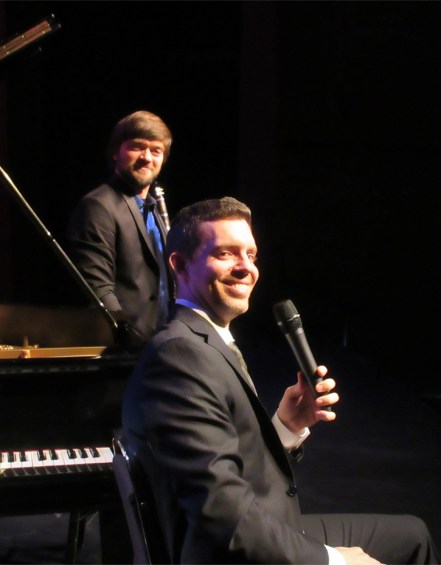
Pianist Chris Donnelly and clarinetist Kornel Wolak

Concert Review: Duo is on a first-name basis with its audience

Pianist Chris Donnelly and clarinetist Kornel Wolak
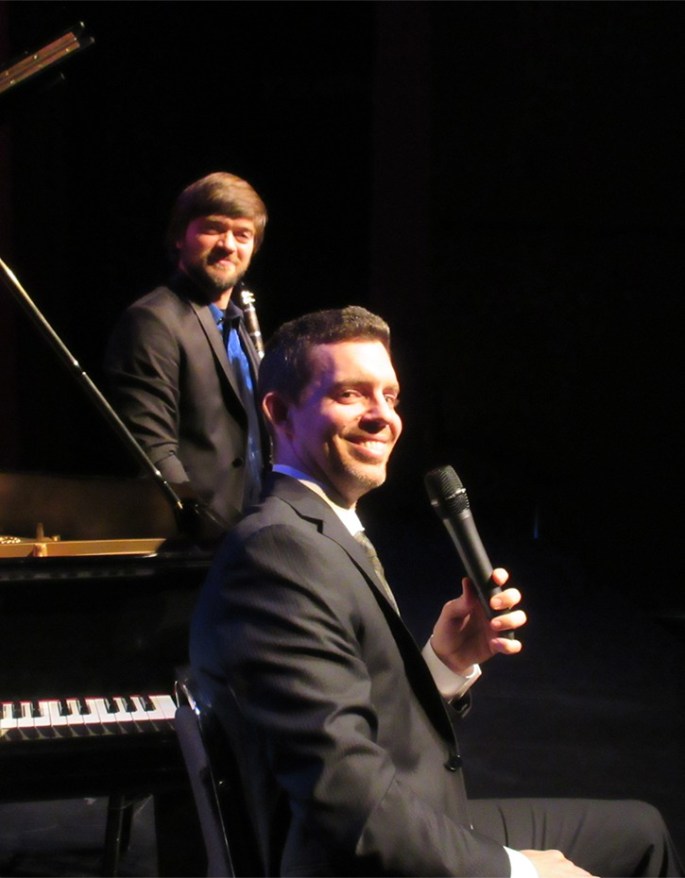
Pianist Chris Donnelly and clarinetist Kornel Wolak take questions from Sunday night’s audience at the Vernon Performing Arts Centre.— image credit: Christine Pilgrim

by  Christine Pilgrim – Vernon Morning Star

The North Okanagan Community Concert audience was treated to an evening of unadulterated excellence by the Wolak Donnelly Duo Sunday.

The two musical showmen had us eating from their hands, from Kornel Wolak’s first explosion on to the stage, with his clarinet slithering through the opening notes of George Gershwin’s Rhapsody in Blue and, soon afterwards, Chris Donnelly’s discreet walk to the piano to join him, precisely on cue.

After they’d bent and moulded the dots to their own unique style and even gleaned applause before the end of Gershwin’s masterpiece, they played a medley from his Porgy and Bess.

We could feel the lazy haze during their rendition of Summertime, and when Wolak played I Loves You Porgy and Bess, You Is My Woman Now with the profound passion demanded of true, lasting love, Donnelly’s accompaniment matched it sublimely.

Wolak admitted, “We played it lovely.” He went on to announce that the duo had covered their gamut of interpretations, and, as a result, the concert was over. He topped our laughter by saying, “But we’ll play the rest of the program to fulfill our contractual obligations.”

The rest of their program did much more than that.

We were on first name terms in no time and primed for more laughs. Chris played his composition about his nightmarish gig at the Edmonton club of a bankrupt called Henry. Kornel told of their Kaslo billet the previous night, when he’d asked their host how many cats he’d lost to coyotes. The casual reply was, “We get through two a year.”

There were also serious moments of great beauty.

For instance, when the two paid homage to Mozart with the Adagio from his Clarinet Concerto in A Major the audience sat, hushed, and finally breathed a collective sigh before letting rip with applause.

And they watched in awe when Kornel played the entire Prelude from Bach’s Cello Suite No. 1, adapted for clarinet, without taking a breath.

We learned about, and practised his circular breathing technique during the duo’s question and answer session in the second half of the program.

But not before we’d been treated to a second contribution by Bach; this time, the Allegro from his Violin Sonata No. 3, played brilliantly on clarinet by Kornel and accompanied spectacularly, on spoons, by Chris. First, they playfully tuned the spoons to the clarinet to enhance this unique experience.

We’d already tasted Chris’ percussive expertise, as well as his clowning ability, when he’d augmented his left hand on piano with maracas in his right, to accompany Kornel’s race through Zequinha de Abreu’s Tico-Tico no Fubá (Swallow in the Corn Meal) made famous by Carmen Miranda in the 1947 movie Copacabana. When the pace grew to fever pitch, Chris threw the maracas over his shoulder and used both hands on the keyboard.

He too had his hour of glory, when he played Hymn to Freedom written by Oscar Peterson to support the Civil Rights movement in 1962.

Wolak and Donnelly topped the evening with their interpretation of Rossini’s Introduction, Theme and Variations. It earned them a spontaneous standing ovation and us the encore: Flight of the Bumblebee.

An all-round entertaining evening opened graciously with music by classical guitarist Brent Matterson.

Christine Pilgrim is a freelance writer who reviews the North Okanagan Community concert season for The Morning Star.
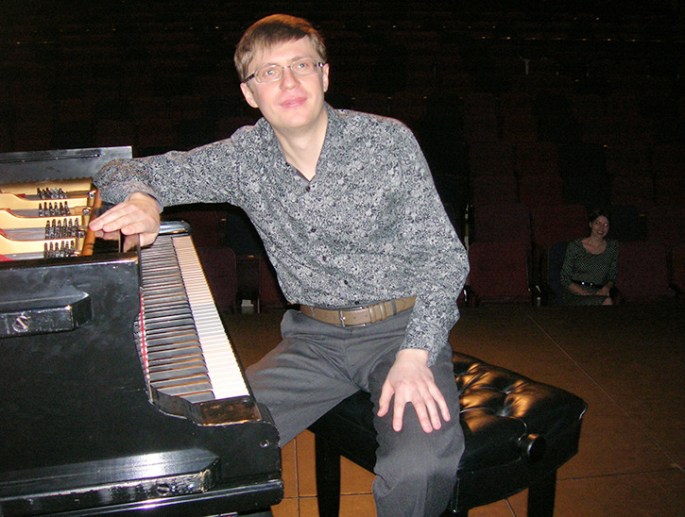
Sergei Saratovsky

Concert Review: Steinway’s last stand

Sergei Saratovsky
Sergei Saratovsky leans against NOCCA’s 1887 Steinway before a performance so dramatic that he and tuner Matt Arnett had to check for broken strings at the Performing Arts Centre Sunday, Feb. 21.— image credit: Christine Pilgrim

by  Christine Pilgrim – Vernon Morning Star

Sunday afternoon on February 21st, 2016 saw the swan song of the North Okanagan Community Concert Association’s 1887 Steinway piano.

It was grand.

NOCCA president Paul Maynes announced that all the keys on the association’s virtual piano, raising funds toward the cost of the association’s replacement Steinway, had been sold.  Only two of its three pedals remained.

When Maynes introduced the curtain raiser, a young lady of poise, grace, talent and charm took her seat at the majestic old instrument.  Megan Van Den Maagdenberg, whom some may have enjoyed at NOCCA’s youth showcase last month, played her own composition, Gentle Defenestration (roughly translated as a gentle push out of a window), and proceeded to accompany herself singing two lovely songs, A Fine, Fine Line and Samson in a clear voice as pure as water tumbling down BX Creek.

She promised an evening of bliss.

And pianist Sergei Saratovsky delivered… He introduced the pieces from a podium, reading from witty, insightful notes in a melodiously thick Russian accent while he saved his hands for his virtuoso performance.

It opened sublimely with two of the 555 sonatas composed by Domenico Scarlatti. The first, in E Major (K.380), still resonates. Its playful successor in G Major (K.146) rippled over the keyboard in response to Saratovky’s rejuvenating touch.

Frédéric Chopin’s famous Minute Waltz followed. If the emphasis is placed on the second rather than the first syllable, minute becomes “minute” (as in “tiny”) and seems a more apt subtitle to Valse in D Flat Major Opus 64 No. 1, particularly as even speedy Saratovsky and precise Streisand, in her Colour Me Barbra sung version, can’t come in under two minutes.

Saratovsky’s segue into Chopin’s second popular waltz in Opus 64, was as seamless as his segue from one Scarlatti sonata to another, as well as those between Anatoly Lyadov’s five preludes in the program’s second half.

Claude Debussy wrote L’isle joyeuse (The Joyful Island) in 1904 when he fell in love on, and with, Jersey, an island in the English Channel. We fell in love too when Saratovsky’s expressive passion conjured pictures of gulls swooping, sun gleaming and waves crashing.

Our dramatic pianist rose breathlessly from Debussy’s climactic ending to introduce Franz Liszt’s Liebestraum (Dream of Love).  He explained Liszt’s three concepts of love: religious, erotic and unconditional, saying, “Liebestraum is a definitive illustration of the latter.”  Then he went on to prove it.

His mastery of all aspects of music was manifested in Liszt’s Fantasia quasi Sonata, written after a reading of Dante’s Divine Comedy.  When Saratovsky’s interpretation of hell, purgatory and paradise ended, my neighbour sighed, “Now I believe in aliens. This man’s superhuman.”

The second half of the program required more work from the audience.

Tchaikovsky’s Dumka (Russian Village) evoked images of cold streets and worn faces. Relief came with Lyadov’s five preludes and a loving anecdote about his laziness.

Lyadov’s magical Music Box also provided a perfect encore to the program which ended with Sergei Rachmaninoff’s mighty Sonata No. 2 in B Flat Minor Opus 36.  Even though this was the shorter version, rewritten in 1931 when Rachmaninoff was 58, its meaty variations between the explosive and lyrical left us, the piano and Saratovsky exhausted.

Apart from this final tour de force, every piece in the program was written when its composer was in his 30s or 40s (including Rachmaninoff’s original manuscript), to contrast our fond, grateful adieu to NOCCA’s much older Steinway.

Christine Pilgrim reviews the North Okanagan Community Concert Association’s season for The Vernon Morning Star.

Audience impressed with NOYSE

92470vernonNOYSEweb
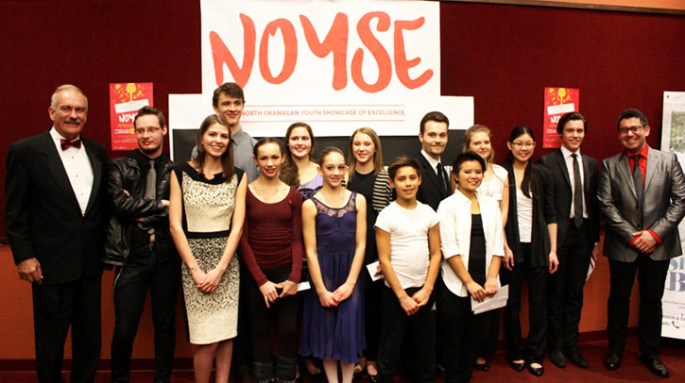
NOCCA president Paul Maynes, left, and pianist Ian Parker, far right, stand with NOYSE performers at the Vernon Performing Arts Centre.

Review by the Vernon Morning Star

The North Okanagan Youth Showcase of Excellence (NOYSE) was “absolutely phenomenal,” according to Gillian Thompson, one of the more than 300 audience members who attended the show Sunday at the Vernon Performing Arts Centre.

“The range of talent took my breath away,” added audience member Marie Morris. “I loved it. I was totally impressed and I’m going to have to watch the progress of these fabulous young performers in the future.”

Put on by the North Okanagan Community Concert Association (NOCCA), the inaugural event featured young performers from Lake Country to the Shuswap, ranging in age from 11 to 22. 

Participants included Brent Matterson (guitar), Brandon Schmor (boogie woogie piano), Megan Van Den Maagdenberg (vocals), Aria Izik-Dzurko (ballet), Holly McCallum (cello), Kendra Jones-Munk (ballet), Anastasia Martens (cello), Jaeden Izik-Dzurko (classical piano), Jonathan Fraser-Monroe (theatrical dance), Hana Friedman (modern dance), and piano trio Melanie Shum (piano), Alyshia Black  (violin), and Mark Casson (cello).

World-renowned Vancouver pianist Ian Parker braved the Coquihalla highway on Sunday morning to host the show as emcee.

“I was absolutely blown away by the level of performance that these kids put on,” he said.

Local musician and instructor Henry Piovesan was also impressed by the young talent on display.

“The NOYSE youth performances were captivating and it is great to know that in this age of instant gratification there still exists a discipline known as practice,” he said. “The work and effort exhibited by these youngsters was evident and judging by the applause and ovations of the very full audience, I am sure this opinion was shared by the majority of attendees.”

NOCCA provided honorariums to all the performers.

“We wanted to showcase the phenomenal talent that our young adults can put on stage in a  professional setting, and I think we succeeded,” said NOCCA president Paul Maynes.

Borealis String Quartet with Imant Raminsh

Concert Review: Borealis Opens Concert Series With Flair

Borealis String Quartet with Imant Raminsh
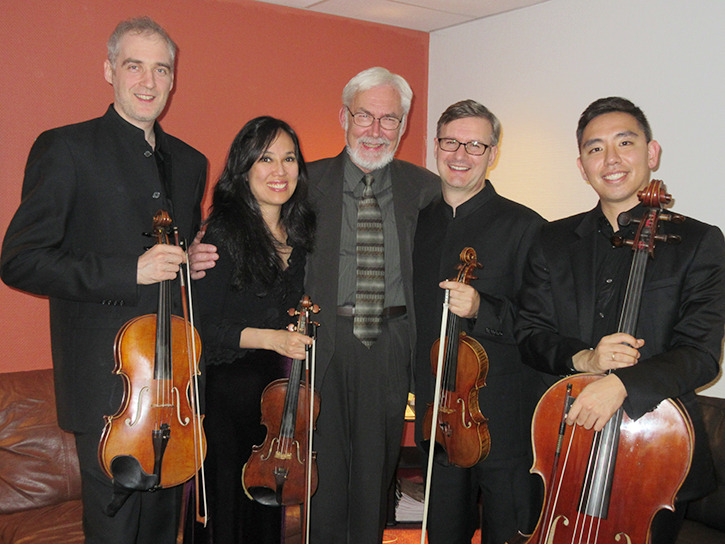
Borealis String Quartet members Nikita Pogrebnoy (left), Patricia Shih, Yuel Yawney and Sungyong Lim celebrate with Coldstream composer Imant Raminsh (centre) after their world premiere performance of Raminsh’s Quartet No 3 at NOCCA’s gala opening of its 2015/16 season Thursday.— image credit: Christine Pilgrim

Review by Christine Pilgrim – Vernon Morning Star

Borealis String Quartet has played prestigious venues in New York, Rome, Beijing and Toronto, but it chose Vernon’s Performing Arts Centre to premiere the work specifically written for it by Coldstream’s Imant Raminsh, at the North Okanagan Community Concert Association (NOCCA) gala opening of its 2015/16 season Thursday, Sept. 24.

When the very first performance of his Quartet No 3 ended, to thunderous applause and a standing ovation, Raminsh quipped with his characteristic twinkle, “I’ve never heard it played so well.”

And indeed Patricia Shih on first violin, Yuel Yawney on second violin, Nikita Pogrebnoy on viola and Sungyong Lim on cello performed with unsurpassed clarity, integrity and artistry; energy too, particularly in Shih’s case.

They enthused about Raminsh’s Quartet No 3 and plan to include it in their regular programming.

“They’re wondering when I’ll come up with Quartet No 4,” said Raminsh. “I’m wondering too. Quartets are hard to write.”

Effusive epithets regarding Borealis’ immaculate precision and musicianship also applied to the other works on the program, Beethoven’s Quartet No 4 in C Minor and Dvorak’s Quartet No 12 in F Major (subtitled the American).  Unlike the American, Raminsh’s Quartet No 3 is not yet subtitled. And instead of an all-encompassing key signature, each of his quartet’s four movements has a kind of tonal centre as a point of departure and return.

Although cellist Sungyong Lim only recently replaced long-time Borealis member Bo Peng, he shone in exquisite solo interludes in the American. In fact, every member shone individually at varying intervals. Their music sounded like a distinguished, mellifluous conversation. When one instrument soared above the rest, the others made room for it.

If only parliamentary debates could be conducted with such delicacy and deftness.

But Borealis members weren’t the only virtuosos on stage. Seventeen-year-old violinist Julien Haynes, accompanied on piano by Lauren Dvorak, opened the concert with Vittorio Monti’s version of the Hungarian traditional dance Czáardás (pronounced shardash), with a maturity beyond his years.

Liszt, Brahms, Delibes and Tchaikovsky have also written versions of Czárdás, which derives from the word czárda, meaning tavern, and, according to some, was used by the Hungarians to inspire their youth to join the military.

However, the audience loved Monti’s version, perhaps because of its familiarity. And everyone loved Haynes’s rendition of it, disregarding the mistake he masked with panache when enthusiasm overtook accuracy towards the end.

One minor disappointment: the audience didn’t “rise to the occasion” to invite the final encore Borealis so richly deserved.  Perhaps they found the program choices too unfamiliar or a tad long. And, despite the elegant stage dressing, flamboyant foyer display and innovative fundraiser, selling piano keys for NOCCA’s replacement Steinway grand, those present didn’t quite embrace the gala spirit that volunteers worked so painstakingly to create.

But they will get another chance to enjoy NOCCA’s diverse programming on November 1 when Christine Tassen et Les Imposteurs perform gypsy jazz with a different flavour, but with the same flair as Borealis.

–  Christine Pilgrim is a freelance writer who reviews the NOCCA season for The Morning Star.

Elektra Women's Choir

Concert Review: Choir Gives An ‘Elektra-fying’ Finale

Elektra Women's Choir
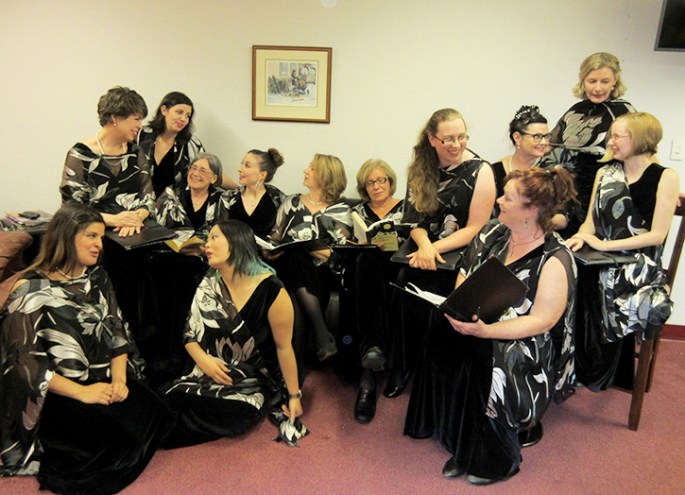
Members of the Elektra Women’s Choir relax in the green room at the Performing Arts Centre before their concert Saturday, May 23.— Image Credit: Submitted

Review by Christine Pilgrim – Vernon Morning Star

The volunteer Vancouver-based women’s choir, Elektra, led by Morna Edmundson, closed the North Okanagan Community Concert Association’s season Saturday, May 23 with professional polish and aplomb.

They were joined for their final piece, David MacIntyre’s Ave Maria, by Ancora, an Armstrong women’s choir led by Terry Logan. Together, they sang a well-earned encore from the auditorium aisles before filing into the lobby to mingle with the audience, thus providing an opportunity to discuss favourite pieces.

Mine was Jerusalem, a traditional Irish folk song arranged by Michael McGlynn, which Elektra also sang from the auditorium aisles. Choir member Grace Groot (first alto) allowed me to peep at her “dots” (a less elevated term for musical manuscript). They showed the song’s haunting, cacophonous refrain inscribed as a round, where singers could join in at whatever point and in whatever rhythm they chose. The sound of anguished yearning that resulted from this random beginning and ending left the audience hushed in a state of awe.

Soloists Danica Kell, Holly Kennedy, Malaika Horswill and Stephanie Schollen were equally effective. Meanwhile, Morna Edmundson stood silently still, listening; a solitary figure on stage, both hands folded before her. She only raised them to conduct the opening of the refrain: “Jerusalem, our happy home, when shall we come to thee? When shall our sorrows have an end?” Elektra-fying!

My second favourite was another traditional song, Russian this time, entitled Ne po pogrebu Bochonochek Kataetsja. Arranged by Kitka, it made an imaginative vehicle for the choristers’ arrival on stage. Instead of dribbling on as is often the case when risers have to be negotiated, they flowed in separate sections and took circuitous routes to arrive at interesting groupings. Their singing was faultless, with pure harmonies and sonorous tones. The marriage between soloists, chorus and percussion in this playful love song bewitched and elevated the spirit.

Da Pacem (Peace) was beautiful too. So was Northern Lights (aurora borealis, which inspired young Norwegian composer Ola Gjeilo to set to music the Pulchra es amica mea text from the Song of Solomon).  Like Da Pacem, it was sung in Latin. An English translation, along with words to every song performed, could be found in the extensive program notes.

A must-mention: when Edmundson called for the house lights to be turned up, they didn’t shine quite brightly enough for everyone to see the finely printed program, contrary to the opinion of someone presumably blessed with 20:49 vision. After a brief word with a helpful usher at intermission, the lights were adjusted to rectify the situation. Bouquets to both usher and lighting technician!

The evening’s favourites also included the curtain raiser, played masterfully by 16-year-old Jaeden Izik-Dzurko. Chopin would surely have delighted in this accomplished young pianist’s interpretation of his Barcarolle Opus 60.

The only male on stage with the 45 female choristers, Dr. Stephen Smith, also deserved applause for his impeccable accompaniment on piano and percussion.

But the last word must remain with those choristers. I confess to a prejudice in favour of the resonant tones of the male voice but their absence paled to insignificance once Elektra began to sing. As NOCCA president Paul Maynes noted, the glory of the human voice raised in song is unmatched. I’d add: of either gender.

The Morning Star contributor Christine Pilgrim reviews the NOCCA concert season.