Bergmann Duo with Sarah Hagen

Review: Three Pianists Negotiate One Piano Keyboard – Beautifully!

Bergmann Duo with Sarah Hagen
Bergmann Duo with Sarah Hagen on Monday April 8th, 2019 at The Vernon & District Performing Arts Centre

Review by Jim Leonard

In spite of the concert being on a Monday night in April, spirits were not dampened! The recently formed quintet comprised of members from 13-20 years of age called “Appassionato,” owned the stage with their enthusiastic version of a Schumann piano quintet.The pianist Henry Baker provided a stable and virtuosic line throughout the composition. There was an effective dialogue between Anton Baker’s viola part and thirteen year old Adam Kunyk’s cello part. Emily Kunyk and Emily Baker provided rock solid solidity in the tempo on their respective violins. I would like to hear this group present a whole concert; their sound was rich and warm.

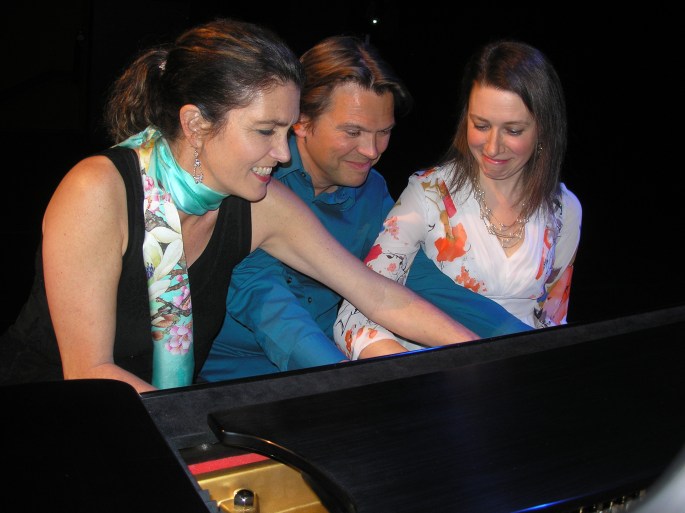
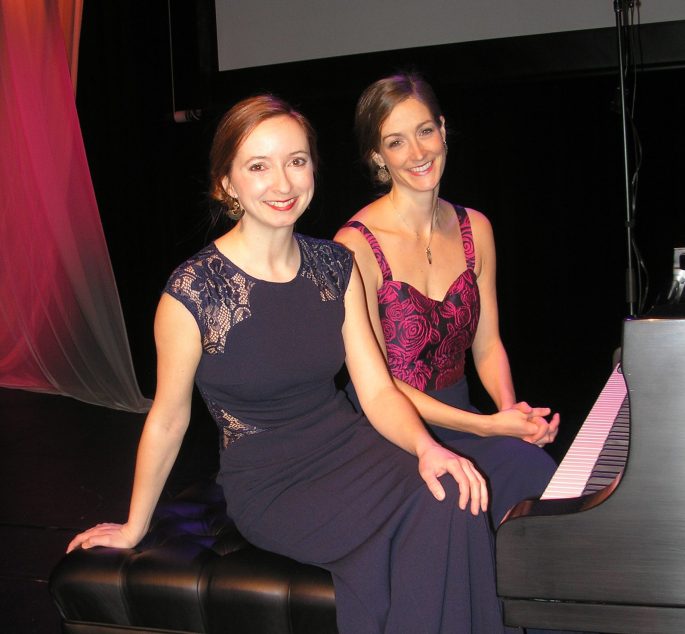
Marcel and Elizabeth Bergmann and Sarah Hagen showed both their versatility and virtuosity throughout this concert which featured music for left hand alone by Marcel Bergmann and music for two to six hands- all on one piano! The pieces for six hands required some very creative seating arrangements – needless to say!

The Prelude for one hand (2019) by Marcel Bergmann began with random bell tone chords. Then a constant ostinato (repeated rhythmic and melodic pattern) was added in the middle giving the effect of two hands playing! Sarah Hagen took the stage to represent two hands playing. She masterfully played three Rachmaninoff Preludes ( #6,7,8 ) from his Opus 32. Each had a varying character: #6 was “stormy” and restless; #7 was like a Russian “Sesame Street” (in Sarah’s words); #8 was effervescent. All were difficult but well played.

The avant garde “Hippocratic Oath” by Mauricio Kagel (1931-2008) – an Argentinian-German composer who developed a theatrical style in his music – was actually written for three hands. One of the hands slapped the bottom of the keyboard in an irregular rhythm at the beginning as if to be independent of the others. The piece ended, however, with all hands stacked together in the air as if to show unity.

After such a piece, the lightness and charm of some of Brahms Waltzes, played in duet form, gave the program a nice turn of events. This breath of fresh air continued with five hands playing Australian-U.S. composer Percy Grainger’s (1882-1961) Zanzibar Boat Song. The music was rich and tune filled; bringing up visions of a brisk sailing trip on a bright sunny day.
Chicago concert pianist-composer Andy Costello (b.1987) is a champion of the music of living composers. His piece “Balance” involved players leaving and returning to the piano to add their voice to the mix.At the climax of this piece, six hands were used (along with creative seating arrangements) to use most of the piano keyboard and create a dense blanket of sound. A rollicking arrangement of Rossini’s “Barber of Seville” by Henri Hausser ended the first half of the programme.

After the intermission,Sarah Hagen played a Piano Sonata in A major by Marianne von Martinez (1744-1812). She was an Austrian composer greatly influenced by the people she shared a house with. In the house (Michaelerplatz), which had four floors, lived a princess from the Esterhazy family; Nicola Porpora – a singing teacher; The Martines family; and in the cold leaky attic, Joseph Haydn. Their lives ultimately became connected through their involvement with Marianna (Porpora taught her voice; Haydn was the accompanist etc). Marianna was the only woman to have written a symphony during the Classic Period. Her Sonata #3 is very much in the style of Haydn and Mozart, with two fast movements divided by a beautiful melancholic Andante movement.

The programme continued with a duet version of three selections from Bernstein’s “West Side Story” with special attention to the haunting “One Hand, One Heart” being the favourite for this reviewer. “ Libertango” by Argentinian composer Astor Piazolla (1921-1992) with it’s infectious rhythms played by four hands; “Romance and Waltz” by Rachmaninoff (1873-1943) using six hands; and the “Radetzky March” by Strauss-also with six hands- were much appreciated by the audience. A hilarious encore which left Marcel Bergmann without a piano part; and resigned to sing like a dejected Cuckoo, with the ladies at the piano; topped off a wonderful evening.

The next NOCCA concert will feature Vox Humana Chamber Choir from Victoria, BC presenting a versatile mix from established to newly commissioned choral repertoire on Saturday April 27, 2019 at 7:30 pm. More info at nocca.ca.

Review by Jim Leonard for the Vernon Morning Star.
Duo Fortin-Poirier

Review: Sparks Fly Off Our Steinway Grand!

Duo Fortin-Poirier
Duo Fortin-Poirier

Review by Jim Leonard

This Valentine Day’s concert began with an appropriate song by Salmon Arm singer Heather Harker; ably accompanied by Alex MacArthur, titled “Les Chemins de L’Amour” (The ways of love) by Francis Poulenc (1899-1963) Heather had a lovely lyrical tone while singing this song.

Heather, a french immersion kindergarten teacher, then showed her teacher’s personality with a dash of humour by performing “Hippo and Gnu” by Flanders and Swan. These selections were greatly enjoyed by the audience.

The performance of Duo Fortin-Poirier was enhanced by the video camera suspended over the piano keyboard; the image was projected on a large screen at the back of the stage. We could see the magic enfolding from the four hands of the duo. In some selections it seemed as though they were competing for keys!

Marie-Christine and Amélie created an intimate and warm atmosphere with their commentary on the pieces which were quite varied in style and texture. Having played together for fourteen years, they showed an extraordinary powerful partnership.

They designed a program which started casually with “Valses Caprice” by Edvard Grieg (1843-1907) and grew in intensity through the “Legends” of Antonin Dvorak(1841-1904) to the pivotal point of the program, “Souvenirs” by Samuel Barber (1910-1981) Here the virtuosity of the performers took flight and never looked back.
The selections after the intermission offered a passionate memorial selection (“Adios Nonino”) by A. Piazzolla (1921-1992), “Chroniques d’une Coupe a blanc” by Canadian composer Vanessa Marcoux (b.1986); Vocalise by Rachmaninoff (1873-1943) arranged by Greg Anderson; and a modern work complete with rhythmic knocking sounds and assaults on the strings in the piano, “Garden of Eden:The Serpents Kiss” by W. Bolcom (b. 1938)
The generous audience rose to their feet in appreciation of an excellent and varied program- brilliantly played. The duo then offered a short encore; a quiet arrangement of Gershwin’s “Summertime.” We almost forgot it was winter!

The next NOCCA concert will feature the Bergmann Duo with Sarah Hagen – an exceptional 6 hands on 1 piano acrobatic musical spectacle on Monday April 8, 2019 at 7:30 pm. More info at nocca.ca.

Review by Jim Leonard for the Vernon Morning Star.
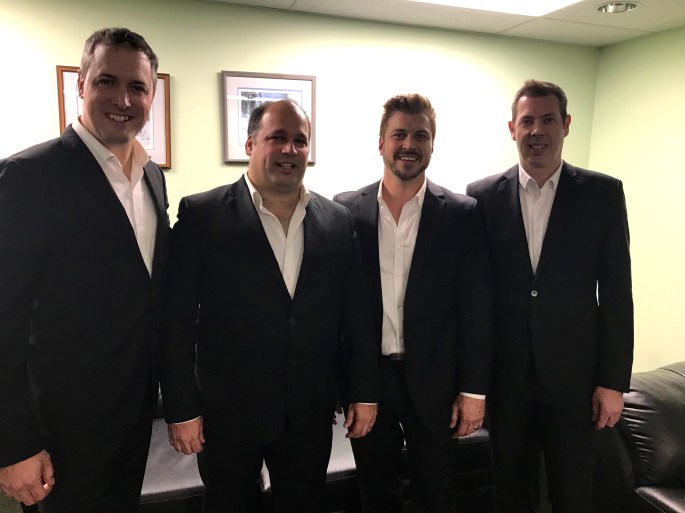
Dynamic Montréal Vocal Quartet Delivers High Octane Evening

Review by Jim Leonard

NOCCA’s gala concert evening on October 27, 2018 began with the stunning violin solos of 13 year old child prodigy Marcus Coetzee. Marcus began playing the violin at age 4! A student of Bev Martens since 2014, Marcus plays in the Okanagan Youth Symphony. He was ably accompanied by local concert pianist Alex MacArthur. Apparently he and Marcus only rehearsed together for 1 hour! Marcus played two selections; the titles of which I obtained from Alex. The first was Souvenir de Saraste by William Potstock (1872-1948) and Czardas by Vittorio Monti (1868-1922) They were both brilliantly played with flawless technique and intonation.

Now to the main event: let me start by saying that the U.K. has the “King’s Singers” but we have “Quartom”- a men’s vocal quartet formed in Montréal in 2008. The name Quartom comes from the French “quatuor d’hommes” meaning men’s vocal quartet. Their program was sung a cappella, without any pitch device. At least one member with perfect pitch was giving the others the tonality which helped the flow of the program. It consisted of mostly
familiar opera and vocal solo music arranged by the members. One exception was an arrangement by Davis, Dixon and Williams of “Duke of Earl”- written and performed by Gene Chandler in 1961.The other was “Mrs. Robinson” (from the movie “The Graduate”) by Simon and Garfunkel. Both selections, like many of the others, were performed with hilarious choreography and/or hand gestures and props.

Other highlights were: an improvised wedding scene between the bass and one of the baritones; complete with bridal bouquet and veil; while the quartet sang Wagner’s wedding processional in German; and Georg (That’s right-no e in German!) Friederich Handel’s “Laschia ch’io pianga” from his opera “Rinaldo.” The group used their incredible control to perform this piece in partial sotto voce (“shadow voice”) to great effect.

They ended the evening with an encore: a short witty song about American youth coming to Quebec to party, because of the lower drinking age there. That was the proverbial “cherry on top of the sundae!” The next concert will be Trio D’Argento on Thursday, November 29, 2018 at 7:30 pm. Flute, clarinet, and piano. More info at nocca.ca.

CRH rehearsing

Review: Pianist gives highly refined concert

CRH rehearsing
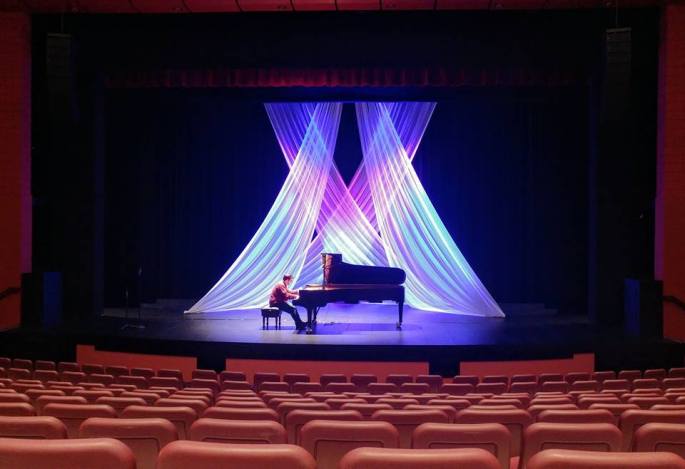
Acclaimed pianist Charles Richard-Hamelin rehearsing before the NOCCA concert

By Jim Leonard

The program began with a tribute to longtime NOCCA board member and past president Paul Maynes. Board member Cathie Stewart presented Maynes with a beautiful painting of an Okanagan valley scene.

Then, as is the custom, a young musician is featured onstage. For this concert, Jenny Sutherland, a student at Seaton Secondary, sang three beautiful songs with her mother at the piano. She had a lovely clear voice for someone who is only 16-years-old. I didn’t catch the titles because no mic was used to announce the songs.

Finally, after much preamble, albeit necessary preamble by NOCCA’S board, we were subjected to a long introduction by the soft-spoken pianist Charles Richard-Hamelin regarding the program. He had chosen the music of two contrasting composers — Robert Schumann in the first half of the program followed by Chopin in the second half.

He began with the Arabesque of Schumann; beginning very quietly, and showing his ultimate control over the piano’s tone. There were many moods in the work, which were deftly and neatly handled by Richard-Hamelin. There were sudden outbursts in the music alternating with quiet contemplative parts. Every note was in it’s place; the runs controlled and clean.

As is the custom with concert pianists, the performance was from memory. How the artist remembered the Fantasie Opus 17 (also by Schumann) was a miracle, as the piece was a good 20 minutes long. As before, there was beautiful contemplative playing; the pianist being careful to not make harsh sounds in the loud, celebratory parts.

For the second half, Richard-Hamelin chose four Chopin Ballades. They were arranged in the program according to the age the composer was at the time of their composition, young to mature. The choice of these works showed the differences in approach, regarding writing for piano, of the two composers. Chopin used extensive melodies with less interruptions in the flow of the harmonies. Of the four Ballades, only the third one was in a major key. It was a refreshing Waltz.

During the playing of the four Ballades, Richard-Hamelin showed tremendous concentration and extreme virtuosity on the keyboard. Again, not a note out of place, seamless runs and brilliant chord patterns abounded. The 12-minute fourth Ballade seemed to sum up Chopin’s total experience as a composer/pianist. Again, brilliantly executed and bringing the audience to their feet.

Their enthusiasm was rewarded with a quiet encore: the slow movement from Bach’s Keyboard Concerto in F minor. Beautiful playing on NOCCA’S wonderful new Hamburg Steinway piano.

The next NOCCA concert is 7:30 pm Saturday April 14, 2018, featuring Vancouver’s EnChor choir. Click here for more information.

Review By Jim Leonard For The Vernon Morning Star

Review: Season’s Opening Concert Delights Audience

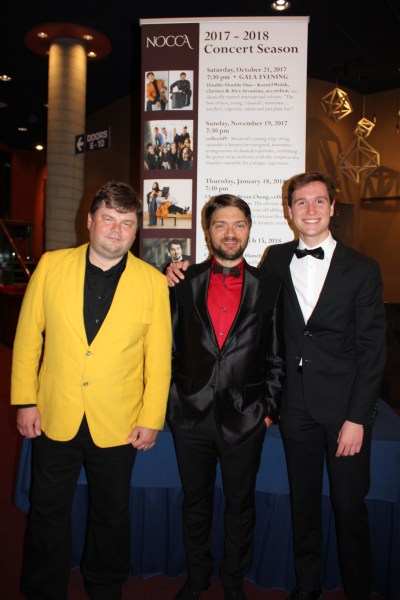
Left to right - Alexander Sevastien, Kornel Wolak and Christopher Dlouhy
Left to right – Alexander Sevastien, Kornel Wolak & Christopher Dlouhy at NOCCA’s 2017-18 Season Opening Concert on Oct. 21, 2017.

By Jim Leonard

The NOCCA season started off very well with Christopher Dlouhy playing two wonderful piano selections.(Christopher is a student of Marjorie Close. He has taken a year off from school to achieve the ARCT diploma.) The first was Arabesque No. 1 by Debussy; it was full of transparent, colourful harmonies and carefree melodies. Christopher had a marvelous touch for this piece and responded to its many moods appropriately. The second piece was Scherzo by Oscar Morawetz (1917- 2007) who emigrated to Canada in 1940 from Bohemia (now the Czech Republic) and taught composition at the University of Toronto from 1952-1982. The piece explored the ranges of the piano extensively with casual outbursts of virtuoso runs and quiet moments. This difficult piece was played expertly by Christopher. No doubt a bright future lies ahead for this young and talented musician!

The Double-Double Duo, aka Kornel Wolak playing clarinet and Alexander Sevastian on the Beyan (Russian button accordion) played a spectacular mix of music from baroque selections through to opera and jazz. Both instruments were amplified through the theatre’s house system and reverb was added. This was a good idea because it expanded and clarified the small ensemble’s sound. At times, at the beginning of the program, the amplified clarinet sounded a little shrill when played in the altissimo register. But this was adjusted by the sound tech and became more comfortable.

The duo’s program began with “Summer” from Vivaldi’s “Four Seasons.” This virtuoso string music, arranged for clarinet and accordion, was played crisply by both players with precise ensemble. As their program progressed, they were most charming when they addressed the audience, sharing interesting information about each piece.

Their next offering was 4 Sonatas by Domenico Scarlatti (1685-1757), an Italian harpsichordist who spent most of his life in Spain. The duo teased the audience by offering to play all 550 sonatas beginning immediately, and going into the wee hours of the morning. Wolak stunned the audience with his technique and breath support (circular breathing-a special technique that has the player inhale through their nose while expelling air into the instrument) by playing the difficult keyboard music on his clarinet effortlessly.
Wolak then played 3 of Bach’s Partitas for solo violin unaccompanied. He used his technical mastery and circular breathing technique to great effect in presenting these pieces.

The mood shifted at this point to the music of clarinetist/band director Benny Goodman. The duo’s arrangement of “Flying Home” provided the audience with a wonderful romp through a popular big band tune.

Brahm’s “Hungarian Dances” Nos. 1 and 5, originally written for piano duet, finished the first half of the varied program. We were told that these pieces were written for parties and were very profitable for Brahms. Of the 21 that were written, these two were the favourites.

“Tico-Tico” by de Abreu – a piece about a “nuisance bird” – began the second half. This familiar piece had the audience moving to the music; a strong rhythmic pulse set up by the duo was infectious. Wolak then offered another Bach piece -Prelude from Partita No.1 for solo Cello by Bach. His rendition was quietly reflective with a sotto voce (“shadow voice”) sound which sounded like another wind instrument.

Then it was Alex Sevastian’s turn to showcase his abilities on the beyan, which has 106 buttons for the right hand and 120 for the left. The audience was told during the question and answer segment of the program that his Russian button accordion had advantages over the piano accordion in range for the right hand, and ability to play melodies as well as chords with the left hand. He began his offering with a subtle “Liber Tango” by Astor Piazzola and then a captivating “Don River Rhapsody” by Slava Semenov. This piece utilizes a shaking technique applied to the wind reservoir and changes in timbre via the chin activated board on top of the accordion. Sevastian proved his mastery of the instrument during his playing of this piece. It was stunning.

The satisfying program was rounded off with a bluesy version-  complete with clarinet slides – of Erroll Garner’s “Misty”, and “Intro,Theme and Variations” by Rossini – a thrilling end to the program. As if this wasn’t enough, the generous duo played the “Clarinet Polka” as an encore, much to the delight of the audience.

The next concert features a classical string ensemble – “collectif9” – on November 19th. Click here for more information.

Review By Jim Leonard For The Vernon Morning Star