Imagine 40 voices, 4 different vocal ranges, up to 12 part harmony – all tumbling together in a kaleidoscope of unmatched musical excitement. That’s ELEKTRA WOMEN’S CHOIR.
They burst onto the Vancouver scene in 1987, determined to explore, create and celebrate the repertoire for female voices. They have lived up to their name, “electrifying” audiences with their astonishing depth and richness as they soared into the leadership of international classical women’s choirs. They have truly struck a new chord in women’s choral music. www.elektra.ca.
The evening’s entertainment will start with a performance by talented local young pianist, Jaeden Izik-Dzurko (16) from Salmon Arm. For the final piece of the concert, MacIntyre’s “Ave Maria”, Elektra Women’s Choir will be joined by Armstrong’s 15 voice Ancora Women’s Ensemble (directed by Terry Logan).
Elektra Women’s Choir Concert Program:
Russian Folk Song
Arranged by Kitka
Ne Po Pogrebu Bochonochek Kataetsja
English Folk Song
Arranged by Kathleen Allan
The Maid On The Shore
Joan Szymko
Text: E. E. Cummings
Maggie And Milly And Molly And May
Timothy Corlis
Text: E. Pauline Johnson
Heart Songs Of The White Wampum
Ola Gjeilo
Northern Lights
Intermission
Traditional Irish Melody
Arranged by Michael McGlynn
Jerusalem
James Rolfe
Text: Amanda Jernigan
Lullaby
Franz Schubert
Psalm 23
Jeffrey Enns
Da Pacem
Frode Fjellheim
Eatnemen Vuelie
David MacIntyre
Ave Maria
Joined by Ancora Women’s Ensemble
SINGLE CONCERT TICKETS
Adults – $35 Under 18 – $17.50
Students on the eyeGo program – $5
Alysha Black plays Bruch’s Violin Concerto in D Minor before the North Okanagan Community Concert Association’s presentation of the Bergmann Duo, at the Performing Arts Centre. — image credit: Christine Pilgrim
By Christine Pilgrim – Vernon Morning Star
Sixty years ago, it was common to see a piano in a living room, with a stash of music nearby.
Many of us stumbled through that music while others became more proficient and some even experienced the thrill of finishing on the same beat in a duet. But none, save perhaps a precious few, could even come close to the skill with which Elizabeth and Marcel Bergmann (of the Bergmann Duo) entertained at the North Okanagan Community Concert Association’s penultimate concert of the 2014/15 season.
The precision, proficiency and unity with which they played contrasted sharply with their easy style and sense of competitive fun when they introduced the pieces.
A case in point was their introduction to the fifth of Maurice Ravel’s fairytale tunes written for his friends’ children in his Mother Goose Suite (Ma Mere l’Oye). It was entitled Conversations of Beauty and the Beast.
“I’ll play Beauty; you can be the Beast,” said Elizabeth to her husband as he picked up her translation from the French text that accompanied the tune.
When the Beast (Marcel) protested his love for Beauty (Elizabeth) she suggested in true wifely fashion that he could show more feeling. Both then proceeded to do exactly that on NOCCA’s celebrated, soon-to-retire Steinway grand.
Friday’s program opened with Variations on a Theme of Robert Schumann Opus 23. Johannes Brahms wrote them after Schumann’s attempted suicide and subsequent insistence that he be admitted to an asylum near the family’s Dusseldorf home. The variations’ haunting sadness reflects Brahms’ feelings of loss and admiration for his friend and mentor. And the Bergmanns’ sensitive interpretation paid tribute to both great composers.
There followed four of six little pieces (Six Morceaux Opus 11) by Sergei Rachmaninoff. The Bergmanns didn’t include Chanson Russe, based on an obscure Russian folk song, nor Romance, which might have been too cloying for these light-hearted lovers. But the remaining four compensated royally, with Barcarolle in G Minor. (Its rich, mysterious tones reminded its publisher of “a gondolier navigating Venetian canals beneath a moonlit sky.”) A sprightly Scherzo led to an intense Valse that provoked the duo to sway in rhythm as their hands flew over the keys and flicked through the pages of music. The Morceaux ended with the monumentally majestic Slava.
The Bergmann Duo did equal justice to Czech composer Erwin Schulhoff’s two “morceaux” from his Dadaesque Ironien Opus 34. Schulhoff was one of the first Europeans to weave jazz into classical music but his place in musical history was cut short by his untimely death in Wultzburg Concentration Camp in the 1940s.
The program ended with Henry Levine’s arrangement of George Gershwin’s Rhapsody in Blue, which brought the house down… and up, in an inevitable standing ovation.
The Bergmanns’ virtuosity shone again in their encore, when they tangoed on both keyboard and piano stool in perfect time, tune and harmony. That tango, once described as “a vertical expression of a horizontal intent,” left no more to be said except that this month’s curtain raiser, Max Bruch’s Concerto in D Minor, was beautifully performed by local violinist Alysha Black, accompanied by Arnold Draper.
A slightly shaky beginning did not diminish the depth of feeling with which this gifted young musician interpreted Bruch’s intricate work.
It’s no wonder the B.C. Touring Council nominated NOCCA as presenter of the year. Its final concert this season features the Elektra Women’s Choir at the Vernon Performing Arts Centre May 23, 2015.
– Freelance writer Christine Pilgrim reviews NOCCA’s concert season for the Vernon Morning Star.
BERGMANN DUO – piano
Friday April 24, 2015 7:30 pm BUY TICKETS
ELIZABETH and MARCEL BERGMANN are a duo – in marriage and in music. For more than two decades their energetic and eclectic keyboard concerts have inspired audiences around the world. They play with such passion it makes audiences hold their breath. As a result, they’ve been gathering accolades and awards along the way. Their incredible repertoire ranges from Bach to Bartok, Liszt to Gershwin, Schumann to Stravinsky. Always adventurous, the Bergmanns combine virtuosic dedication with the instincts of professional entertainers who love sharing their music with an audience. www.bergmannduo.com
4 Hands, 1 Piano – Concert Program:
J. Brahms
(1833-1897)
Variations on a Theme by Robert Schumann Op. 23
Rachmaninoff
(1873-1943)
4 pieces from Six Morceaux Op. 11
Intermission
M. Ravel
(1875-1937)
Mother Goose Suite (Ma Mère l’Oye)
E. Schulhoff
(1894-1942)
2 pieces from Ironien Op. 34
George Gershwin
(1898-1937)
Rhapsody in Blue (arr. H. Levine)
SINGLE CONCERT TICKETS
Adults – $35 Under 18 – $17.50
Students on the eyeGo program – $5
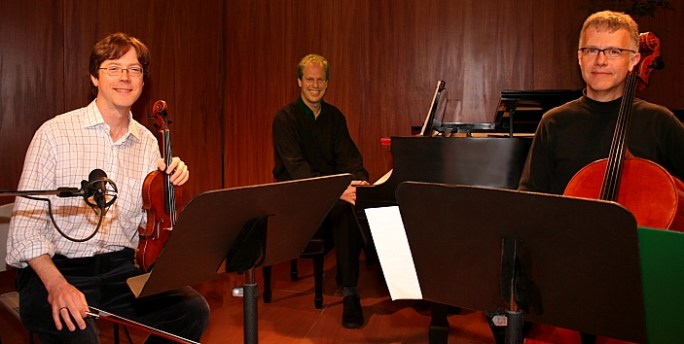
JOE TRIO – piano, violin and cello
Saturday March 21, 2015 7:30 pm BUY TICKETS
Joe Trio
These classically-trained musicians fit perfectly into the Kaleidoscope theme. They won’t to be neatly categorized! Instead, JOE TRIO strives for diversity, versatility, more than a little humour and unpredictability.
Their repertoire consists of the classics – from Papa Haydn to Uncle Shostakovich – new works by contemporary composers, and their own arrangements of popular, jazz and rock tunes. More than virtuosi, the Trio’s members are fantastic performers who engage the audience in a way few classical musicians can. Witty, charming, and tremendously musical, Joe Trio leaves audiences with a new appreciation for classical music. www.joetrio.com
SINGLE CONCERT TICKETS
Adults – $35, under 18 – $17.50
Students on the eyeGo program – $5
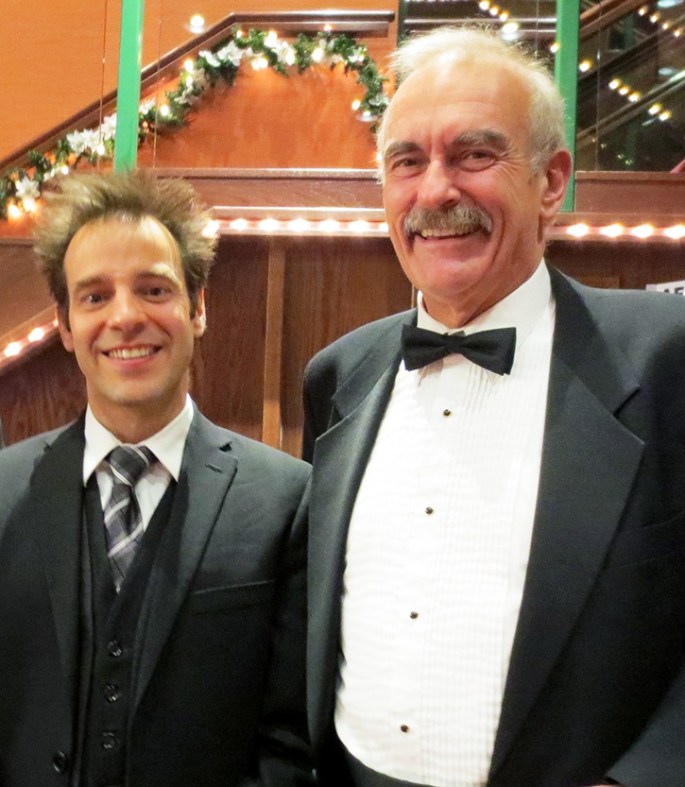
Virtuoso horn player Louis-Philippe Marsolais (left) and North Okanagan Community Concert Association president Paul Maynes.
By CHRISTINE PILGRIM for The Vernon Morning Star.
Les Violons du Roy, its name adapted from that of the string orchestra that played for a 17th century French king, awed Tuesday’s North Okanagan Community Concert Association’s gala audience with music fit for any king, or queen for that matter.
One young man said afterwards, “This review should be easy to write. One word: wow!” That sentiment was confirmed by NOCCA president Paul Maynes, who overheard the same expletive countless times during intermission.
There was no opportunity to speak with OSO conductor Rosemary Thomson or the horn players who had flocked specifically to hear Haydn’s glorious Horn Concerto No 2 in D Major, played mellifluously by Louis-Philippe Marsolais, but judging by their faces after the show, they felt the same way.
The energy of this supremely accomplished ensemble of French Canadian musicians infected the Performing Arts Centre like a fever – a fever that acted as a tonic. Music coursed through every vein, from stage to auditorium. There were even enthusiastic bouts of applause between movements from some who were too carried away to check their program notes.
Conductor Mathieu Lussier’s body language was reminiscent of that of a Martha Graham trained dancer. He was engaged in music-making from the top of his head to the tip of his toes, and the orchestra responded as one body. We could well have been witnessing a ballet. The atmosphere was electric.
The program opened with Haydn’s Horn Concerto. Although this piece was originally written for “natural horn” virtuosos, Marsolais played it on the more modern French horn, which, incidentally, originated in Germany and is not to be confused with the English horn, which is French (loosely quoting the hilarious soprano Anna Russell).
When asked why he didn’t play his baroque horn, Monsieur Marsolais said it was too difficult and dangerous to transport two precious, cumbersome instruments on the company’s current exhaustive tour of Western Canada.
No matter. The notes he produced flowed like chocolate from a fountain and captivated the audience entirely. They say a horn player needs a five-litre lung capacity. Marsolais’s might well have exceeded that!
He also charmed the audience with a second appearance in Schumann’s Adagio and Allegro, Opus 70, which he orchestrated.
Then there was Felix Mendelssohn’s String Symphony No 10 in B Minor. The child prodigy wrote it in May, 1823 when he was 14 and performed its premiere with a string quintet at his parents’ opulent Berlin home.
The energy and precision with which Les Violons du Roy interpreted their arrangement of its only surviving movement, which begins mournfully, continues with a recurring theme and ends in a vibrant climax, wrought spontaneous applause and added to the wonder that a 14 year old could achieve such a degree of excellence.
Franz Schubert’s String Quartet No 14 in D Minor, known as Death and the Maiden, brought the concert to a rapturous close. Violin soloist Pascale Giguere particularly shone, as did leading players on second violin, viola and cello. Arranged by Lussier, who recently took over the reins from ensemble founder and former director Bernard Labadie while he battles ill health, was a coup de gras.
A standing ovation was rewarded by J.S. Bach’s Air on G String, which evoked sighs of recognition from the packed rows of happy music lovers.
Those unfortunate enough to miss the concert might console themselves with one of the 29 CDs made by this fantastic chamber orchestra from Montreal.
– Reproduced by kind permission of Christine Pilgrim and The Vernon Morning Star.





 North Okanagan Community Concert Association