Lafayette and Saguenay String Quartets

Octet Gives Twice the Sonic Pleasure!

Lafayette and Saguenay String Quartets

Review by Jim Leonard

October 26th’s NOCCA concert began with Angela Zeng; a 14 year old grade 9 student at Kalamalka S.S. and a member of the OSYO since the age of 9. She showed confidence and skill as she produced a large bold tone on her cello for three unaccompanied Bach pieces – Prelude, Saraband and Gigue. Pianist Alex MacArthur joined her as piano accompanist for a lively Tarantella. She has come far after only 7 years of study.

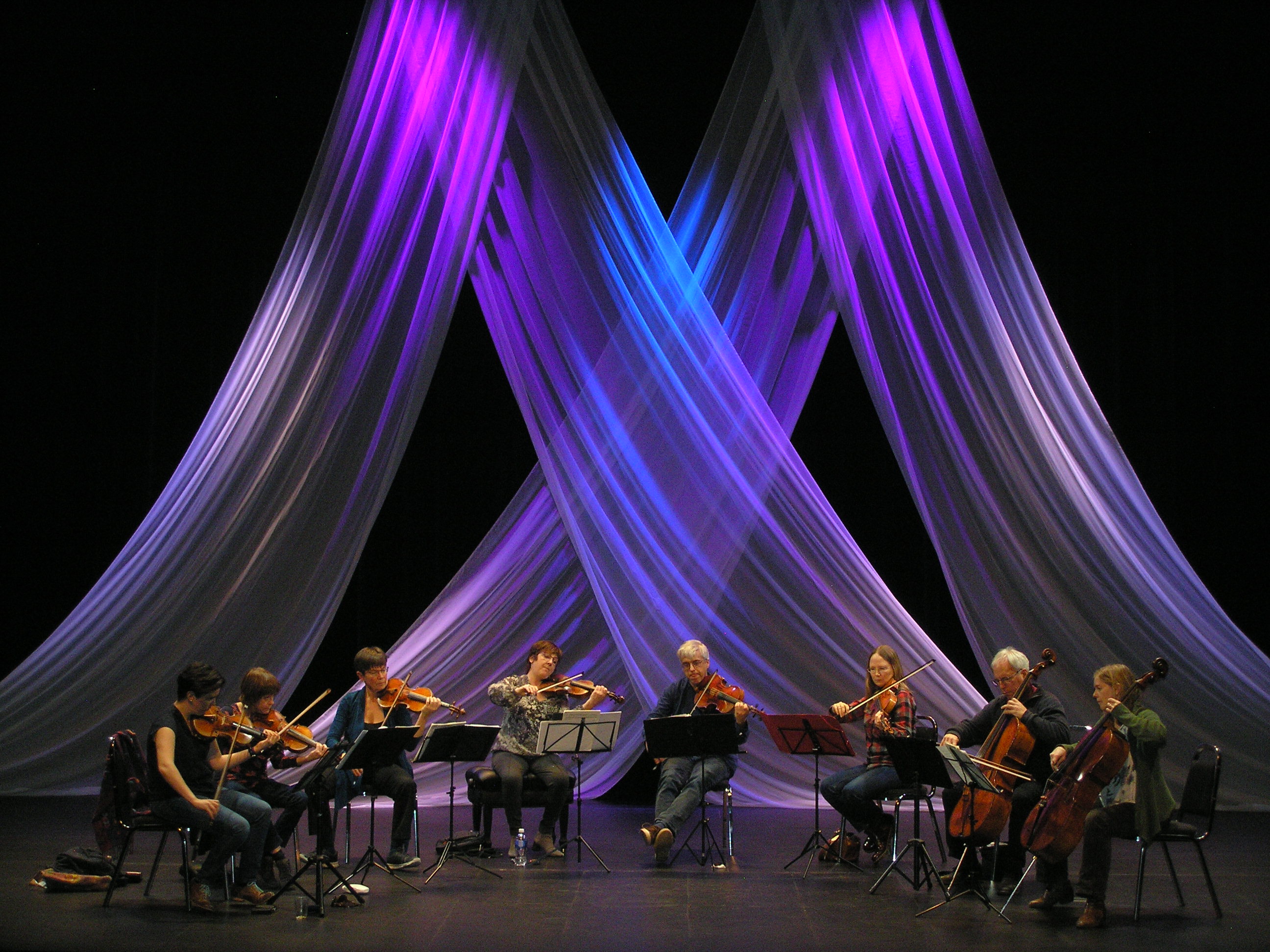
The combination of the Lafayette and Saguenay String Quartets proved to be a very successful venture. Their sound was very rich and full, never harsh even in the loudest sections.

First on the programme was the octet by Danish composer Niels Gade (1817-1890). Gade was influenced by Danish folk tunes and an older contemporary, Felix Mendelssohn (1809-1847). The four movement String Octet in F op.17 may have been a tribute to Gade’s friend and mentor Mendelssohn.It was played with great precision and energy. Incidentally, an Octet isn’t just an expansion of a quartet. It changes texture randomly from any number of parts up to and including eight different parts. There were solos which randomly appeared in any of the parts. They were all brilliantly played.

The String Octet in G minor “The Letter” by Airat Ichmouratov (1973- ) was a type of tone poem following the story of a woman of poor birth and exceptional beauty, who spent her childhood living close to a well off older man and eventually falling in love with him. After an encounter with him she conceived a son who died in childhood.The letter describing her unrequited love is delivered to the child’s father after her death.This piece was commissioned by the Saguenay Quartet and based on Stefan Zweig’s novella “Letter from an Unknown Woman”. It was full of anguished and rich harmonies appropriate to the story, but the long intro by one of the cellists before the piece disturbed the flow of the evening, and what he said was stated in the program anyways.

Actually at this point I would like to mention that there were too many announcements before and during the program- plus a presentation. All this added a half hour down time to the evening and detracted from the flow of the concert. After intermission, The String Octet in Eb major op.20, written by the 16 year old Felix Mendelssohn, was presented. The playing of this piece was excellent but this reviewer (through no fault of the performers) found the first movement overly long, maybe a young man trying to show off his skills? The next 3 movements were brilliantly played, bringing the evening to a sparkling ending.There was no encore, but the audience seemed satisfied with the bountiful musical offering from this stunning group.

The next NOCCA concert is on Sunday December 1, 2019 at 7:30 pm and will feature the Sords-Severn-Duvall Trio performing Beethoven, Brahms, Ravel and Severn. More information at nocca.ca.

Review by Jim Leonard for the Vernon Morning Star.
Vox Humana Chamber Choir

Stunning Victoria Choir Gives Flawless Concert!

Vox Humana Chamber Choir

Review by Jim Leonard

This concert was held over from the original date in April. The choir wasn’t able to leave Vancouver Island because of high winds at that time. They actually spent some terrifying hours on a ferry that was tossed about, and managed to return to port.

The concert began customarily with some local guest artists; this time Keanna Burgher and Charlotte Backman – both veterans from Melina Moore’s Valley Vocal Arts program.They warmed up the crowd nicely with God Bless The Child, Being Alive and Secondary Characters sung as a duet. Their confidence and experience shone through. They were ably accompanied by Alex MacArthur on the piano.

There was some confusion about which programme was being presented by the choir – the one in the insert or the one on the April concert sleeve. Conductor Brian Wismath cleared it up by announcing that the insert pieces were the evening’s programme – all pieces by Canadian composers of the 20th Century.

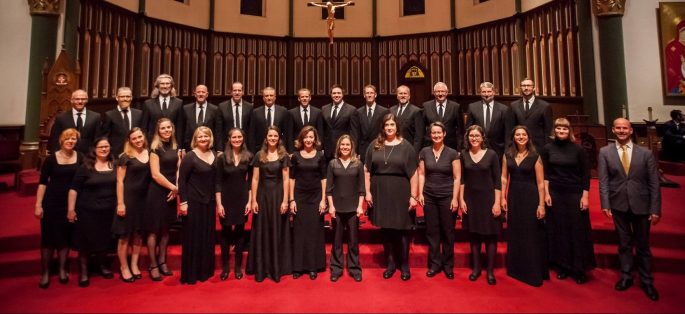
Throughout the difficult program – all sung a cappella (no accompaniment) – the choir showed their confidence and produced a flawless blend of tone, perfect tuning and tight ensemble. Kudos to Brian Wismath for his excellent rehearsal technique.

The first half of the program was the most enjoyable for the reviewer. Two pieces by Kathleen Allan – Stars and Thou My Soul May Set in Darkness – showed a mastery of compositional techniques including fugue (complicated round; first part called an exposition). Stars by Ashley Bontje had lovely pentatonic (five-note pattern) melodies woven together.

Certainly the most entertaining piece was by Chris Sivak – Alouette Meets Her Maker – in which the choir produces sounds associated with the decommissioned satellite of the 1970s. The imagination of the composer produces a sequel to the decommissioning after 10 years – with an unexpected reboot after 30 years. There is radio chatter, buzzing, blips and bleeps, all ending with a ‘Whoosh!’ which marked the final destruction of the circuits.

The first half of the program ended with seven parts from Estonian composer Urmas Sisask’s Gloria Patri sung in Latin. All movements were based on only five selected notes. Number one was the Gloria Patri beginning in the style of a church motet, and then using a quartet singing in unison, sounding medieval. The perfect blend of the choir was very evident through this section.

The Sanctus had a lively bouncing rhythm which was perfectly executed by the choir. This was carried out again in the Gloria. The last movement, the Agnus Dei sounded very sombre and penitential out of which grew some simple imitation.The ending had multiple repeats of the phrase Dona Nobis Pacem with long breaks in between. Kudos to the audience for not interrupting with premature applause. You could hear a pin drop!

The second half began with Kitchener-Waterloo composer Jeff Enns’ Psalm 23; it was in the style of a Tudor church anthem with modern harmony. Again perfect tuning and blend were displayed by the choir. Enn’s second piece was a lament about a little girl suffering the experiences at a Residential school. It was called I Lost My Talk.

I didn’t quite grasp the point being made by The Gracious Exchange by Christine Donkin, but it was beautifully sung regardless. The Heaven’s Flock (Eriks Esenvalds) used dense harmony and experimented with various textures- it was a bit beyond my liking but well sung.

The encore – David Bowies’ Space Oddity was just that – odd. Anyways, the audience went away satisfied after hearing this wonderful choir!

The next NOCCA concert will feature Saguenay and Lafayette String Quartets on Saturday October 26, 2019 at 7:30 pm. More information at nocca.ca.

Review by Jim Leonard for the Vernon Morning Star.
Bergmann Duo with Sarah Hagen

Review: Three Pianists Negotiate One Piano Keyboard – Beautifully!

Bergmann Duo with Sarah Hagen
Bergmann Duo with Sarah Hagen on Monday April 8th, 2019 at The Vernon & District Performing Arts Centre

Review by Jim Leonard

In spite of the concert being on a Monday night in April, spirits were not dampened! The recently formed quintet comprised of members from 13-20 years of age called “Appassionato,” owned the stage with their enthusiastic version of a Schumann piano quintet.The pianist Henry Baker provided a stable and virtuosic line throughout the composition. There was an effective dialogue between Anton Baker’s viola part and thirteen year old Adam Kunyk’s cello part. Emily Kunyk and Emily Baker provided rock solid solidity in the tempo on their respective violins. I would like to hear this group present a whole concert; their sound was rich and warm.

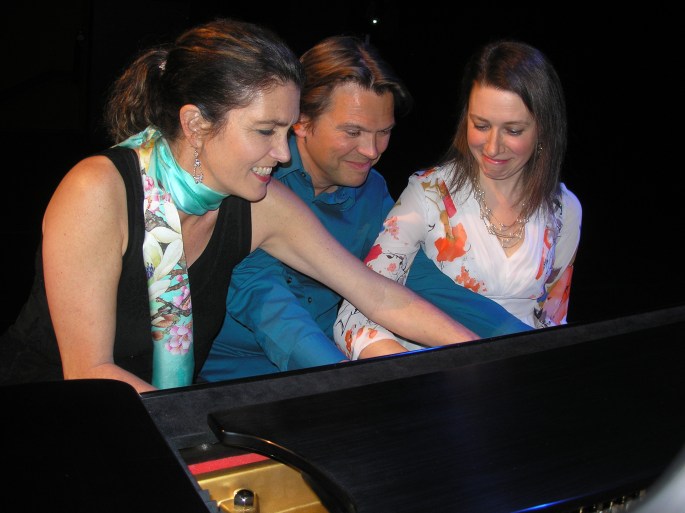
Marcel and Elizabeth Bergmann and Sarah Hagen showed both their versatility and virtuosity throughout this concert which featured music for left hand alone by Marcel Bergmann and music for two to six hands- all on one piano! The pieces for six hands required some very creative seating arrangements – needless to say!

The Prelude for one hand (2019) by Marcel Bergmann began with random bell tone chords. Then a constant ostinato (repeated rhythmic and melodic pattern) was added in the middle giving the effect of two hands playing! Sarah Hagen took the stage to represent two hands playing. She masterfully played three Rachmaninoff Preludes ( #6,7,8 ) from his Opus 32. Each had a varying character: #6 was “stormy” and restless; #7 was like a Russian “Sesame Street” (in Sarah’s words); #8 was effervescent. All were difficult but well played.

The avant garde “Hippocratic Oath” by Mauricio Kagel (1931-2008) – an Argentinian-German composer who developed a theatrical style in his music – was actually written for three hands. One of the hands slapped the bottom of the keyboard in an irregular rhythm at the beginning as if to be independent of the others. The piece ended, however, with all hands stacked together in the air as if to show unity.

After such a piece, the lightness and charm of some of Brahms Waltzes, played in duet form, gave the program a nice turn of events. This breath of fresh air continued with five hands playing Australian-U.S. composer Percy Grainger’s (1882-1961) Zanzibar Boat Song. The music was rich and tune filled; bringing up visions of a brisk sailing trip on a bright sunny day.
Chicago concert pianist-composer Andy Costello (b.1987) is a champion of the music of living composers. His piece “Balance” involved players leaving and returning to the piano to add their voice to the mix.At the climax of this piece, six hands were used (along with creative seating arrangements) to use most of the piano keyboard and create a dense blanket of sound. A rollicking arrangement of Rossini’s “Barber of Seville” by Henri Hausser ended the first half of the programme.

After the intermission,Sarah Hagen played a Piano Sonata in A major by Marianne von Martinez (1744-1812). She was an Austrian composer greatly influenced by the people she shared a house with. In the house (Michaelerplatz), which had four floors, lived a princess from the Esterhazy family; Nicola Porpora – a singing teacher; The Martines family; and in the cold leaky attic, Joseph Haydn. Their lives ultimately became connected through their involvement with Marianna (Porpora taught her voice; Haydn was the accompanist etc). Marianna was the only woman to have written a symphony during the Classic Period. Her Sonata #3 is very much in the style of Haydn and Mozart, with two fast movements divided by a beautiful melancholic Andante movement.

The programme continued with a duet version of three selections from Bernstein’s “West Side Story” with special attention to the haunting “One Hand, One Heart” being the favourite for this reviewer. “ Libertango” by Argentinian composer Astor Piazolla (1921-1992) with it’s infectious rhythms played by four hands; “Romance and Waltz” by Rachmaninoff (1873-1943) using six hands; and the “Radetzky March” by Strauss-also with six hands- were much appreciated by the audience. A hilarious encore which left Marcel Bergmann without a piano part; and resigned to sing like a dejected Cuckoo, with the ladies at the piano; topped off a wonderful evening.

The next NOCCA concert will feature Vox Humana Chamber Choir from Victoria, BC presenting a versatile mix from established to newly commissioned choral repertoire on Saturday April 27, 2019 at 7:30 pm. More info at nocca.ca.

Review by Jim Leonard for the Vernon Morning Star.
Duo Fortin-Poirier

Review: Sparks Fly Off Our Steinway Grand!

Duo Fortin-Poirier
Duo Fortin-Poirier

Review by Jim Leonard

This Valentine Day’s concert began with an appropriate song by Salmon Arm singer Heather Harker; ably accompanied by Alex MacArthur, titled “Les Chemins de L’Amour” (The ways of love) by Francis Poulenc (1899-1963) Heather had a lovely lyrical tone while singing this song.

Heather, a french immersion kindergarten teacher, then showed her teacher’s personality with a dash of humour by performing “Hippo and Gnu” by Flanders and Swan. These selections were greatly enjoyed by the audience.

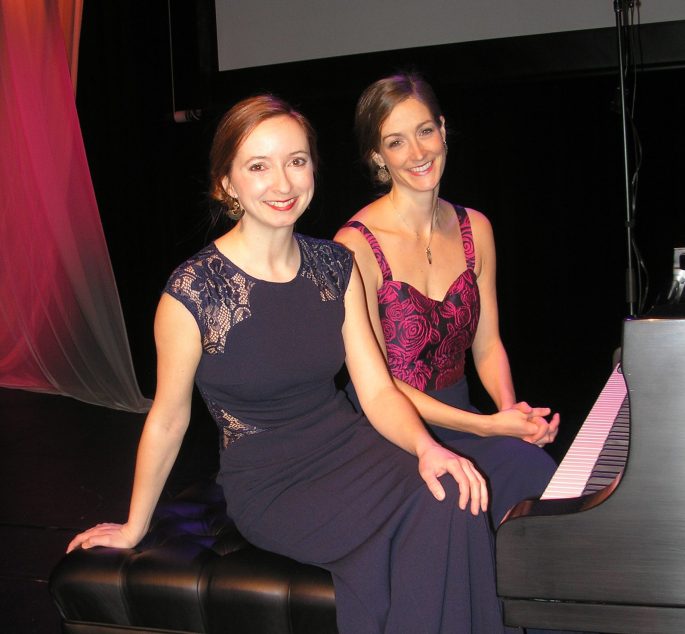
The performance of Duo Fortin-Poirier was enhanced by the video camera suspended over the piano keyboard; the image was projected on a large screen at the back of the stage. We could see the magic enfolding from the four hands of the duo. In some selections it seemed as though they were competing for keys!

Marie-Christine and Amélie created an intimate and warm atmosphere with their commentary on the pieces which were quite varied in style and texture. Having played together for fourteen years, they showed an extraordinary powerful partnership.

They designed a program which started casually with “Valses Caprice” by Edvard Grieg (1843-1907) and grew in intensity through the “Legends” of Antonin Dvorak(1841-1904) to the pivotal point of the program, “Souvenirs” by Samuel Barber (1910-1981) Here the virtuosity of the performers took flight and never looked back.
The selections after the intermission offered a passionate memorial selection (“Adios Nonino”) by A. Piazzolla (1921-1992), “Chroniques d’une Coupe a blanc” by Canadian composer Vanessa Marcoux (b.1986); Vocalise by Rachmaninoff (1873-1943) arranged by Greg Anderson; and a modern work complete with rhythmic knocking sounds and assaults on the strings in the piano, “Garden of Eden:The Serpents Kiss” by W. Bolcom (b. 1938)
The generous audience rose to their feet in appreciation of an excellent and varied program- brilliantly played. The duo then offered a short encore; a quiet arrangement of Gershwin’s “Summertime.” We almost forgot it was winter!

The next NOCCA concert will feature the Bergmann Duo with Sarah Hagen – an exceptional 6 hands on 1 piano acrobatic musical spectacle on Monday April 8, 2019 at 7:30 pm. More info at nocca.ca.

Review by Jim Leonard for the Vernon Morning Star.

Trio D’Argento visiting Okanagan Lake, Vernon BC

Review: Trio Delivers Virtuosic Concert

Trio D’Argento visiting Okanagan Lake, Vernon BC

Review by Jim Leonard

As is customary, each concert features a local artist to begin the program. This time it was Katherine Flaherty; a lovely soprano who offered two familiar and most enjoyable song selections. She had a perfect clear tone for Schubert’s “Ave Maria” and gave a lovely gentle version of Puccini’s “O Mio Bambino Caro.” She was ably accompanied by pianist Alex MacArthur.

“Trio d’Argento” comprised of: Sibylle Marquardt on alto flute, flute and piccolo; Peter Stoll on E flat and B flat clarinets, and Bass clarinet; and Todd Yaniw, piano started their program with Haydn’s “Trio in D”. Originally for other instruments, it was arranged by Peter Stoll. The music was light and bubbly in the hands of the trio. The bass clarinet provided some unique sounds to the ensemble in this work, which originally had the part for cello. Camille Saint-Saens’ (1835-1921) “Tarantella”, marked Presto non Troppo – “Very fast but not out of control” (my translation!) showed the trios ability for precise ensemble and neat playing.

The third set of pieces were by bassoonist-saxophonist Russell Peterson (b.1969). Peterson is an associate professor of music studies at Concordia College in Minnesota. His “Trio for Flute, Clarinet, and Piano” (2009) was the first piece in the program that wasn’t an arrangement. It started mysteriously, depicting a desolate desert scene with chant like melodies. This gave way to a lively market scene with all its hustle and bustle. The trio controlled the changes in character with breathtaking ease. There were colourful overtones created by the flute and clarinet; both in their highest registers. Peterson’s piece ended with a whirling dervish of sound in the Allegro. After this piece some sonic soothing was required, and it arrived with Jacques Ibert’s “Deux Interludes.” Ibert (1890-1962) was an actor, composer and silent film pianist. We were bathed in lovely melody and soothing sonorities from the trio.

Kevin Lau, born in Hong Kong, became the Toronto Symphony’s affiliate composer in 2012; holding that position until 2015. His “Musica Universalis” gave the trio an opportunity to unleash their arsenal of instruments into the realm of Quantum Physics – the awe of the universe. Movement one called “Frozen Fire” started with the pianist creating a shimmering effect on the upper part of the keyboard; one could imagine the array of colours occurring when light strikes the ice surface. “Singularity” (2nd movement) helped us envision a black hole in the universe. ”The End of Eternity” used musical styles from Bach’s fugues, Beethoven and romanticism. During these pieces we heard piccolo, flute, Eb clarinet, Bb clarinet, and bass clarinet and of course the virtuosity of Yaniw, the pianist.

The last programmed piece was “Techno Parade” by Guillaume Connesson (b.1970). In this piece we heard some prepared piano (placing objects on the strings) and jazz flute. At times it sounded like a video game! The trio immersed themselves into the turmoil of the piece and came out the winner using their incredible virtuosity. The enthusiastic audience demanded and encore and got two: The Duet from “Lakme” by Leo Delibes (1815-1910) originally for two sopranos, but skill fully arranged for the trio; and the “Pink Panther” by Henry Mancini. What a night it was!

The next NOCCA concert will be the piano duo “Duo Fortin-Poirer” on Thursday February 14, 2019 at 7:30 pm. More info at nocca.ca.

Review by Jim Leonard for the Vernon Morning Star.