Hagen & Butterfield

Concert review: tenor-pianist delight with musical medley

Hagen & Butterfield
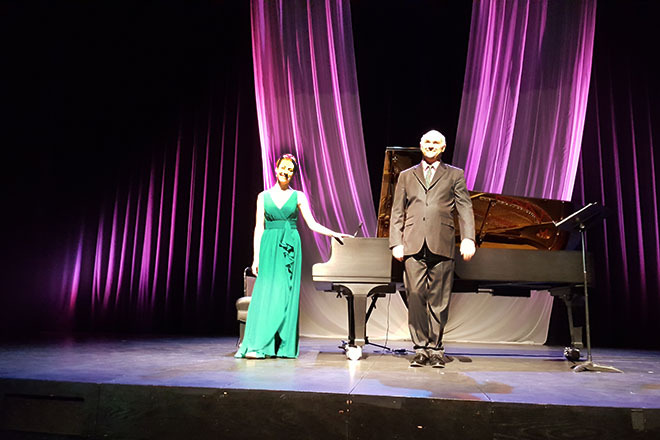
Pianist Sarah Hagen and tenor Benjamin Butterfield delight the audience at their Vernon concert Sunday Feb. 26th 2017— image credit: Natalia Polchenko

By Natalia Polchenko
For The Morning Star

If I were to write a Twitter review of Sunday’s North Okanagan Community Concert Association concert by Benjamin Butterfield and Sarah Hagen, it would go something like this: “Lyrical. Whimsical. Intimate. Multicultural. Excellent!”

Thankfully, I have a little bit more space to share my impressions.

There were a couple of coughs heard before opening act Shae Fraser, a young local harpist, touched the strings of her beautiful instrument. The quiet sound of the harp gentle and meditative immediately put the audience into enchanted calm. All the worries and bustle left the Vernon Performing Arts Centre and the music took everyone on a delightful journey.

The headliners, tenor Benjamin Butterfield and pianist Sarah Hagen, both internationally acclaimed musicians, put together a fantastic program that gave the audience a taste of music from many cultures. There were only two people on the large stage, an unamplified voice and piano, but they were able to create the very intimate and warm atmosphere of a cozy house concert.

Traditional Songs from five Canadian Regions, arranged by Canadian composer John Beckwith, reflected the eclectic nature of Canadian culture. Five distinctly different musical traditions wrapped in four different languages (Gaelic, English, French, and Hungarian) created a festive mood, representative of the Canadian cultural mosaic.

Next, Butterfield and Hagen exposed the audience to German lieder. If you ever wondered whether lieder, a traditional setting of German poems to music, could be appreciated fully by non-German speakers, Butterfield and Hagen were a perfect team to make a believer out of you. The singing, playing, and body language of the musicians were so expressive that you could not help but feel the poetry.

The selection of pieces was very interesting. They featured composers from different musical eras Mozart, Wolf, Reger, Mahler, and Schönberg yet, the lyricism shared a distinct common thread. The lyrical and precise voice of Butterfield and the emotional but delicate playing of Hagen suited the music perfectly. My personal favourites were the exquisite Mozart’s Abendempfindung (Evening Sensations) and atonal, but oh-so expressive and flowy Waldsonne (Sun in the Forest) by Arnold Schönberg.

After intermission, the multicultural musical kaleidoscope kept turning. Hagen, who was instrumental in helping choose the NOCCA’s new grand piano (pun intended), played a Rachmaninoff Prelude with great sensitivity and heart. Russian romantic music seamlessly transitioned to a cycle of Five Greek Songs by French musical impressionist Maurice Ravel. Ravel wrote this song cycle in a mere 36 hours in French rather than Greek, which made for another charming touch of cultural variety in the program.

Butterfield and Hagen then switched gears from lyrical to whimsical. Two songs by Harry Nilsson, Puppy Song and Nobody Cares About the Railroads Anymore, and a four-song selection by M. Flanders and D. Swann, showcased the duo’s comedic talent. The images Butterfield painted with words, sounds, whistling, facial expressions and gestures were palpable. The piano was there every step of the way. Even the pauses were expressive.

The audience was thoroughly entertained even when the tenor forgot a few words. However, Butterfield was able to make comedy out of his mistake.

In the finale, we joyfully joined the musicians in one of the Queen’s favourite songs, The Hippopotamus, with “mud, mud, glorious mud…” Joy was a very distinct aftertaste of this delightful matinée and the audience carried it away with them.

The North Okanagan Community Concert Association presents as its last concert of the 2016-17 seasonDuo Rendezvous” featuring violinist Jasper Wood and guitarist Daniel Bolshoy, 7:30 pm on March 18th at the Performing Arts Centre. Tickets are available at the Ticket Seller box office, 250-549-7469 or ticketseller.ca.
 

soucy and bolduc ensemble

Concert review: cool jazz at its finest

soucy and bolduc ensemble
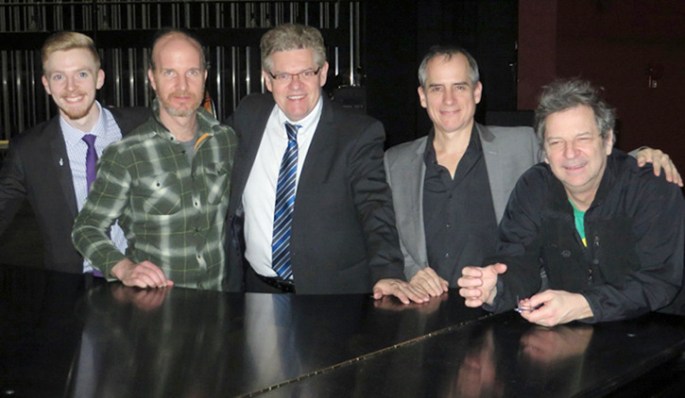
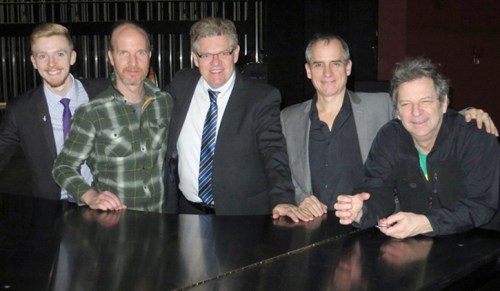
W.L. Seaton Secondary student Jacob Soucy, left, joined members of the Rémi Bolduc Jazz Ensemble, Fraser Hollins, Bolduc, Dave Laing and François Bourassa, at the Vernon Performing Arts Centre Jan. 28, 2017

By Jim Leonard
For The Morning Star

The volunteers of the North Okanagan Community Concert Association’s music committee must be thanked for their hard work in bringing first-class entertainment to Vernon.

Saturday’s performance of the Rémi Bolduc Jazz Ensemble was certainly up to the committee’s high standards. But if that wasn’t enough, we were treated to an up-and-coming jazz quartet led by W.L. Seaton Secondary’s jazz phenom Jacob Soucy to start the wonderful evening.

The members, Soucy (trumpet), Craig Matterson (piano), Isley Owens (upright bass), and pinch-hitter drummer Jason Martin, wowed the audience with their take on jazz standards and an original composition by Soucy called Chocolate Milk.

Soucy then joined Bolduc’s group to play There Will Never Be Another You and held his own quite nicely.

We were informed by an earlier article in The Morning Star that Bolduc’s ensemble would not be creating a carbon copy of Brubeck’s albums. The only similarity I noticed was Bolduc’s alto sax tone. It was very close to Paul Desmond’s lighter cool jazz tone.

Many of the arrangements featured long cadenzas at the end or exploratory and wistful piano intros. I was impressed by the group’s ensemble and by the intonation of Bolduc’s sax and the upright bass played by Fraser Hollins. As I am a gigging keyboardist, I know it is a challenge for such players to adjust to the intonation of the piano.

Two arrangements stood out: Take 5 had a unique intro by pianist extraordinaire François Bourassa. He reached into the piano and created a “prepared piano” sound with his left hand resulting in a muted percussive effect. Normally this effect is accomplished by placing various small objects on strategic parts of the piano’s strings, which produce harmonics and other effects. The piece was then played as Brubeck and his quartet would have done. It was there that all similarities ended. The harmony changed and so did the 5/4 meter. The quartet began to develop the familiar opening melody in a symphonic style, teasing the audience with little snippets of the theme passed around instrument to instrument while changing its characteristics ever so slightly. To top it all off was a brilliant drum solo by Dave Laing.

The other outstanding arrangement was the group’s take on Bluette, which started with Bourassa offering an intro not unlike the music of Russian composer/pianist Alexander Scriabin (1872-1915). The arrangement had many different tonal colours, complete with a soul-searching bass solo and frisky duet between the sax and piano to finish the piece.

Other honourable mentions offered were Blue Rondo a la Turk, where the group ignored the irregular note groupings outlined in Brubeck’s piece written in 9/8 time (2+2+2+3), to create a galloping infectious groove by using the usual 3+3+3 note groupings imposed on the melody.

The other piece was Charles Matthew Hallelujah in which many short Hallelujahs à la George Frederick Handel passed between the instruments.These were interrupted by a fast 4/4 swing that jazz players call a “burner.” Within this piece were altissimo sax notes (beyond normal range) and fast scales. This all settled down, prompted by a nice bass solo, to an excellent drum solo using brushes.

The standing ovation given by the audience was rewarded with a version of The Duke, featuring duets between sax and the other quartet members. I hope for this group’s return to Vernon in the near future.

The next NOCCA concert Feb. 26 will feature pianist Sarah Hagen with tenor Benjamin Butterfield. Tickets are still available at ticketseller.ca

– Jim Leonard is a Vernon-based musician who reviews the North Okanagan Community Concert Association series.

ian parker and jaeden izik-dzurko

Concert Review: Piano makes a stunning debut

ian parker and jaeden izik-dzurko nocca concert
International renowned pianist Ian Parker and his student Jaeden Izik-Dzurko of Salmon Arm, relax after performing in a piano duo on the North Okanagan Community Concert Association’s new and retiring Hamburg Steinway pianos at the Vernon Performing Arts Centre, Oct. 29. — image credit: Jay Schappert

By Jim Leonard – a special review for The Vernon Morning Star

Brilliant pianist Ian Parker delighted the audience as he performed on the North Okanagan Community Concert Association’s new Hamburg Steinway piano Saturday, Oct. 29th at the Vernon Performing Arts Centre.

The soloist for the evening, Ian Parker, was also a charming host, sharing interesting tidbits about the composers and their music throughout the evening. He came with his own theme for the concert, “Variations on Inspirations.” His program featured a number of theme and variations compositions, starting with Joseph Haydn’s Variations in F minor.

From the moment I heard the first few notes, I knew NOCCA had acquired a beautiful instrument. Parker’s playing brought out the sparkle in the many trills and runs found in Haydn’s music.

Next on the program were arrangements of two Franz Schubert songs by Franz Liszt. The first one, Gretchen at the Spinning Wheel, incorporated some of Schubert’s descriptive accompaniment, an urgent, incessant whirling of notes depicting the spinning wheel’s movement, while adding thickness to the texture. In the midst of this was the actual melody, normally sung, but skillfully emphasized by Parker’s playing.

The second piece Singing Over the Water, was challenging and complicated, but no problem for Parker. He maintained poise and clarity throughout the piece.

Beethoven’s Sonata Opus 26 allowed us to hear the clarity and richness of the bass range of the piano. It all just seemed to make sense. Every note rang true under Parker’s fingers.

The sonata itself breaks away from strict sonata form and begins with a theme and variations. More and more of the piano’s range is explored in this sonata, from deep dark bass chords to sparkling high notes.

Movement two had a sprightly scherzo and trio, which provided contrast to the more academic sounding variations. The funeral march in movement three brought out the dark colouring available on such a splendid instrument. Parker managed some wonderful sotto voce (shadow or distance sound) in the quieter parts of this movement, giving it a hushed reverence. In contrast there were regal fanfare figures played crisply by Parker as if the dead were rising up.

The fourth movement, Escape from the Body, was a toccata in a classical style. It employed a technique involving rolling the wrists outwards while playing a series of fast notes. Again, no problem for Parker.

At this point in the program, contrast was provided by Three Preludes by George Gershwin. Number one was a type of tone poem that depicted daily life in New York City with all its business and traffic noise. Number two was a cool bluesy piece, which Parker swung by making the eighth notes uneven. It was perfect with many colours of tone coming from the piano.

Number three was in the style of a Spanish rhapsody with intoxicating rhythms and exotic melodies at the end of which Parker jumped up off the piano bench during the last note as if to shout “Ole!” The already charmed crowd loved it.

After intermission, Parker played Johannes Brahms’ Variations and Fugue on a Theme by Handel. He commented on the fact that Brahms loved the structures found in baroque music. A case in point is the fugue, a form perfected by J.S. Bach, which finishes the variations. Brahms infuses romantic force into the variations and the fugue, setting the piece apart from the baroque style.

This piece was an excellent choice by Parker. It was very complex and dense in texture and showed how well the piano and performer could hold up under intense pressure from so many notes.

For the finale, Parker brought his student, Jaeden Izik-Dzurko, a Grade 12 student from Salmon Arm, out to join him in Lutoslawski’s Variations on Paganini for Two Pianos.

When you see this young man’s credentials –– associate of the Royal Conservatory of Music, grand prize winner of the Canadian Music Festival National Competition, soloist with the Kamloops and Okanagan Symphony Orchestras  –– you have to be impressed. His talent is a credit to Parker’s great teaching skills.

On stage were both the new and retiring Steinways. The piece required the utmost in virtuosity from both pianists. They met the challenge with ease.

Congratulations to all who had a part in bringing the new piano to our stage, especially Parker, who introduced the instrument to us in a most stunning way.

Guest reviewer Jim Leonard is a Vernon-based pianist, organist and composer.

Concert Review: piano-cello duo electrifies

dyachvkov and saulnierBy Jim Leonard – a special review for The Vernon Morning Star

The North Okanagan Community Concert Association (NOCCA) kicked off its season Thursday September 22nd with a rapturous performance by cellist Yegor Dyachkov and pianist Jean Saulnier.

Saulnier began by commenting, “this is not a cello accompanied by piano concert. We are equal partners in the music we have chosen.”

He and Dyachkov proceeded to demonstrate exactly what that statement meant.

The Five Pieces in Folk Style Opus 102 by Robert Schumann was played with great sensitivity. Both players were careful not to assert their part over the other.

Schumann cleverly wrote the music to portray: “With Humour; Slowly; Not Fast; Not Too Surprising and Strong and Marked.” The duo brought these titled works to life.

Brahms wrote his Sonata in E minor Opus 38 for an advanced amateur cellist. It was in three movements: Allegro ma non troppo (Lively but not too much so); Allegro quasi Menuetto – Trio (Lively in the style of a minuet with contrasting trio) and Allegro. Even though the title seemed to indicate a cello sonata accompanied by piano; this was not the case.

The most interesting part of this sonata was the last movement, which contained a fugue (a complex round). The fugue was Brahm’s homage to J.S. Bach’s masterwork The Art of the Fugue. It had the style of Bach’s fugal writing. The notes were passed seamlessly between the piano and cello and gave the impression of a much larger ensemble.

After intermission came Dimitri Shostakovich’s Sonata in D minor.

Throughout the four movements the moods oscillated between miserable, hopeful and urgent. Shostakovitch’s Russia was ruled by the tyrant and mass murderer Joseph Stalin. Stalin banned Shostakovitch’s music, calling it “chaos instead of music.” To the uninitiated, the melodies and harmony may have been too restless.

This listener enjoyed some of the other techniques involved in playing a cello throughout the sonata: pizzicato (plucking the strings instead of bowing them), applying a mute to the bridge of the cello, and portamento (sliding the fingers up and down the fingerboard while bowing). The virtuosic piano part was played brilliantly with the cello following suit.

After a standing ovation, the duo offered a short, quiet encore: Sappiche Ode by Brahms, a perfect end to a wonderful concert.

As is customary at NOCCA concerts, some young up-and-coming talent was also featured. The cello duo of Anastasia Martens and Holly McCallum (both in their early teens) presented some Bach arranged for two cellos.

Both girls showed their abilities and confidence in their playing. Their sound was warm and large and their ensemble playing was excellent.

Watch out world!

The next NOCCA concert is October 29, 2016 featuring pianist Ian Parker and the “new” (1979) Hamburg Steinway grand piano. It will be a gala event where everyone is invited to dress “to the nines” in formal wear. Check out NOCCA’s website nocca.ca, or facebook for the latest news and reviews. Lastly,  many thanks to the NOCCA organization for bringing such stellar talent to the North Okanagan!

Guest reviewer Jim Leonard is a Vernon-based pianist, organist and composer.

Concert review: NOCCA season ends in a melding of cultures

nOCCAChoirs-review
Members of Kokopelli, University of Pretoria Youth Choir and Okanagan Indian Band Cultural Immersion School Choir mingle in the Marie Fleming Room at the Performing Arts Centre before their concert — image credit: Christine Pilgrim

Below is a review of the fabulous final concert of NOCCA’s 2015/16 season. Don’t forget you can now reserve your seats and subscribe to the upcoming 2016/17 season “A Grand Year to Hear” at ticketseller.ca

Review published on April 29th, 2016 by  Christine Pilgrim – Vernon Morning Star

There aren’t enough superlatives in English to describe the North Okanagan Community Concert Association’s offering of African music. So, in Zulu: hle kakhulu!

Three youth choirs, numbering almost 150 members in total, graced the Performing Arts Centre stage and, as one audience member observed, “Every face was beautiful,” in creating a rainbowed feast of united energy, rhythm and song.

It’s rare to see a standing ovation halfway through a program but that’s what we saw when the University of Pretoria Youth Choir  (UPYC) performed We Dance from the musical Once on This Island.

The song tells of the conflict between landowners and peasants who come together through dance because “if the gods move our feet, we dance.”

The gods surely moved UPYC’s feet, and their voices, regardless of which language they used.

It’s also rare to hear applause for an introduction. That, too, was the case when visionary UPYC choir director, Lhente-Mari Pitout, spoke of her South African “born free generation,” choir members who are “at peace with each other in the realization that we are all connected with the same spirit.”

Pitout went on to state what is possible if we forgive.

She rehearses with students from 36 different South African high schools for several hours once a week. The result was an ocean of music and movement that gratified the soul.

We tasted Africa’s sunshine and smelled its warm rain, while Pitout spoke of the choir’s wonder at the still lingering snow at Silver Star.

She thanked Kokopelli Youth Choir’s founder and artistic director, Scott Leithead, for sponsoring UPYC and countless other African choirs over the past 20 years.

Among those choirs was one from Namibia. Its soloist, Nelson Nagenda, was featured in Kokopelli’s outstanding opening segment.

His voice blended sublimely with the young man’s mature interpretation in both the Zulu gospel prayer, Phind’ukhulume, and the North American hit, It’s Almost Like Being in Love, sung back in the 1940s by Frank Sinatra, Nat King Cole, Judy Garland and, later, Gene Kelly in the filmBrigadoon.

But none touched Nagenda’s style nor that of the 11 Kokopelli members who accompanied him, vocally creating musical instruments, percussion and harmonies.

Perhaps it’s unjust to single out favourites. The whole was equal to the sum of its parts, and that sum was beyond measure.

It included pint-sized members of the Okanagan Indian Band Cultural Immersion School’s choir, who gave a prayer and welcome song in the Syilx language. And they observed elder Madeline Gregoire’s instruction before the show, to remember they were not there for themselves.

All three choirs performed “off book.” The resulting freedom of movement and expression paid huge dividends, particularly for UPYC and Kokopelli. Simple but effective choreography, steeped in the essence of Africa, prompted another audience member to say, “It makes you want to go there.”

If unable to do so, we were at least blessed to experience some of the finest choral music produced anywhere.

– Christine Pilgrim is a freelance writer who reviews the North Okanagan Community Concert Association series for The Morning Star.

Reserve your seats and subscribe to the upcoming 2016/17 season “A Grand Year to Hear” at ticketseller.ca