NOCCA’s gala concert evening on October 27, 2018 began with the stunning violin solos of 13 year old child prodigy Marcus Coetzee. Marcus began playing the violin at age 4! A student of Bev Martens since 2014, Marcus plays in the Okanagan Youth Symphony. He was ably accompanied by local concert pianist Alex MacArthur. Apparently he and Marcus only rehearsed together for 1 hour! Marcus played two selections; the titles of which I obtained from Alex. The first was Souvenir de Saraste by William Potstock (1872-1948) and Czardas by Vittorio Monti (1868-1922) They were both brilliantly played with flawless technique and intonation.
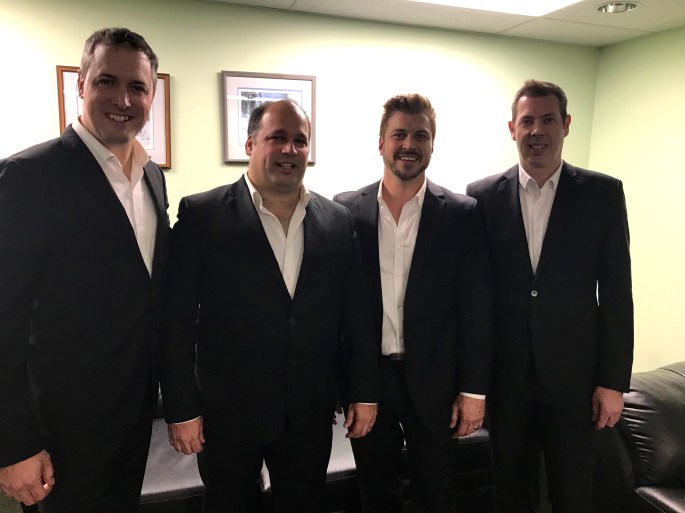
Now to the main event: let me start by saying that the U.K. has the “King’s Singers” but we have “Quartom”- a men’s vocal quartet formed in Montréal in 2008. The name Quartom comes from the French “quatuor d’hommes” meaning men’s vocal quartet. Their program was sung a cappella, without any pitch device. At least one member with perfect pitch was giving the others the tonality which helped the flow of the program. It consisted of mostly
familiar opera and vocal solo music arranged by the members. One exception was an arrangement by Davis, Dixon and Williams of “Duke of Earl”- written and performed by Gene Chandler in 1961.The other was “Mrs. Robinson” (from the movie “The Graduate”) by Simon and Garfunkel. Both selections, like many of the others, were performed with hilarious choreography and/or hand gestures and props.
Other highlights were: an improvised wedding scene between the bass and one of the baritones; complete with bridal bouquet and veil; while the quartet sang Wagner’s wedding processional in German; and Georg (That’s right-no e in German!) Friederich Handel’s “Laschia ch’io pianga” from his opera “Rinaldo.” The group used their incredible control to perform this piece in partial sotto voce (“shadow voice”) to great effect.
They ended the evening with an encore: a short witty song about American youth coming to Quebec to party, because of the lower drinking age there. That was the proverbial “cherry on top of the sundae!” The next concert will be Trio D’Argento on Thursday, November 29, 2018 at 7:30 pm. Flute, clarinet, and piano. More info at nocca.ca.
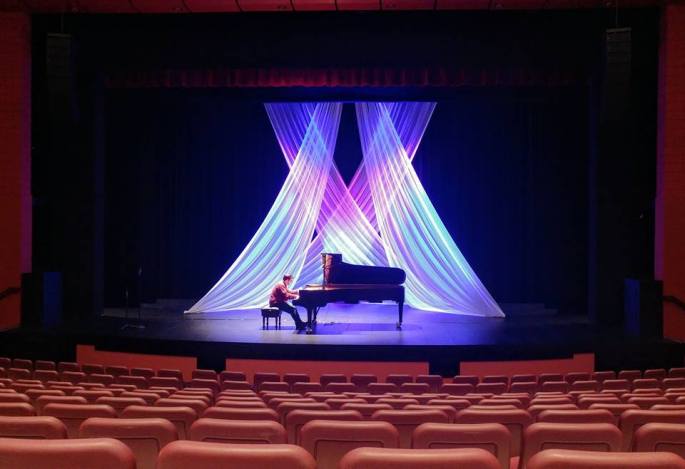
Acclaimed pianist Charles Richard-Hamelin rehearsing before the NOCCA concert
By Jim Leonard
The program began with a tribute to longtime NOCCA board member and past president Paul Maynes. Board member Cathie Stewart presented Maynes with a beautiful painting of an Okanagan valley scene.
Then, as is the custom, a young musician is featured onstage. For this concert, Jenny Sutherland, a student at Seaton Secondary, sang three beautiful songs with her mother at the piano. She had a lovely clear voice for someone who is only 16-years-old. I didn’t catch the titles because no mic was used to announce the songs.
Finally, after much preamble, albeit necessary preamble by NOCCA’S board, we were subjected to a long introduction by the soft-spoken pianist Charles Richard-Hamelin regarding the program. He had chosen the music of two contrasting composers — Robert Schumann in the first half of the program followed by Chopin in the second half.
He began with the Arabesque of Schumann; beginning very quietly, and showing his ultimate control over the piano’s tone. There were many moods in the work, which were deftly and neatly handled by Richard-Hamelin. There were sudden outbursts in the music alternating with quiet contemplative parts. Every note was in it’s place; the runs controlled and clean.
As is the custom with concert pianists, the performance was from memory. How the artist remembered the Fantasie Opus 17 (also by Schumann) was a miracle, as the piece was a good 20 minutes long. As before, there was beautiful contemplative playing; the pianist being careful to not make harsh sounds in the loud, celebratory parts.
For the second half, Richard-Hamelin chose four Chopin Ballades. They were arranged in the program according to the age the composer was at the time of their composition, young to mature. The choice of these works showed the differences in approach, regarding writing for piano, of the two composers. Chopin used extensive melodies with less interruptions in the flow of the harmonies. Of the four Ballades, only the third one was in a major key. It was a refreshing Waltz.
During the playing of the four Ballades, Richard-Hamelin showed tremendous concentration and extreme virtuosity on the keyboard. Again, not a note out of place, seamless runs and brilliant chord patterns abounded. The 12-minute fourth Ballade seemed to sum up Chopin’s total experience as a composer/pianist. Again, brilliantly executed and bringing the audience to their feet.
Their enthusiasm was rewarded with a quiet encore: the slow movement from Bach’s Keyboard Concerto in F minor. Beautiful playing on NOCCA’S wonderful new Hamburg Steinway piano.
The next NOCCA concert is 7:30 pm Saturday April 14, 2018, featuring Vancouver’s EnChor choir. Click here for more information.
The concert began with pianist Craig Matterson; an 18 year old graduate of W.L.Seaton Secondary School. Craig offered his own version of Errol Garner’s “Misty.” It started in a meditative style and picked up the pace part way through. Matterson changed the harmony with chord substitutions and created excitement with virtuoso runs. Well done!
The second piece was Rachmaninoff’s “Prelude in C#minor,” which began very mysteriously and quietly; giving a new interpretation to the work. Apparently it represents the lowering of a casket-with a live person in it- into the grave. The restless middle part represents the panic of the person inside the casket. Matterson conveyed this very effectively through his playing. He has a bright future in front of him as a performer, composer and bandmate in his band “Daysormay.”.
Parker Crook gave a thorough introduction of the “collectif 9” (“neuf”-French for 9) in the Nov.17 issue of the Morning Star. As their name indicates, there are nine members in the group from Montreal. They are
all virtuoso string players (4 violins,2 violas,2 cellos and one bass)playing virtuoso parts generated by their bassist Thibault Bertin-Maghit. They were all amplified through the house system. I think they were all brave to do this as any flaw would be amplified. I didn’t hear any flaws all evening. Their ensemble was tight as was their execution of the myriad of notes they had to play.
The repertoire they played was from the classical and romantic eras as well as the avant garde. One piece had a member calling out phrases during the playing. Personally, I thought that one was too long; the idea had run it’s course and the phrases didn’t seem to have any logical order to them. More successful were the two Mahler pieces- “The Hunter’s Funeral Procession” and the “Farewell.” At times I thought I heard a french horn and a flute! Theplayers had done their sonority research and found a way to imitate these
instruments!
The folk music genre was well represented by the “Taraf de Haidouks” by Turceasca; The “Romanian Concerto No.5” by Ligeti; and the “Romanian Folk Dances “ of Bartok.The violin soloists adopted the characteristic swooping between notes which gypsy violinists did in their playing.These pieces were full of energy as the soloists showed off their abilities.
The audience was given two encores; one in the style of a Quebec reel- to which the crowd added their enthusiastic clapping on the beat; and a slow reflective sonorous piece-the announced title’s weren’t audible to me; they didn’t use a mic. If one wanted something completely different- musically speaking, this was the concert to attend. There were unique arrangements played by a brilliantly talented string ensemble.
The next NOCCA concert is on Thursday January 18, 2018. It features the energetically talented “Cheng2 Duo” on cello and piano. Click here for more information.
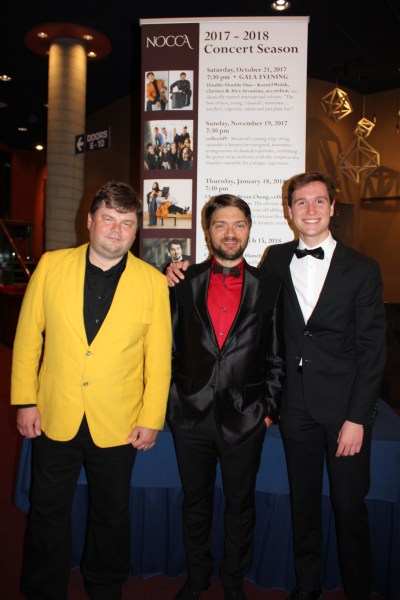
Left to right – Alexander Sevastien, Kornel Wolak & Christopher Dlouhy at NOCCA’s 2017-18 Season Opening Concert on Oct. 21, 2017.
By Jim Leonard
The NOCCA season started off very well with Christopher Dlouhy playing two wonderful piano selections.(Christopher is a student of Marjorie Close. He has taken a year off from school to achieve the ARCT diploma.) The first was Arabesque No. 1 by Debussy; it was full of transparent, colourful harmonies and carefree melodies. Christopher had a marvelous touch for this piece and responded to its many moods appropriately. The second piece was Scherzo by Oscar Morawetz (1917- 2007) who emigrated to Canada in 1940 from Bohemia (now the Czech Republic) and taught composition at the University of Toronto from 1952-1982. The piece explored the ranges of the piano extensively with casual outbursts of virtuoso runs and quiet moments. This difficult piece was played expertly by Christopher. No doubt a bright future lies ahead for this young and talented musician!
The Double-Double Duo, aka Kornel Wolak playing clarinet and Alexander Sevastian on the Beyan (Russian button accordion) played a spectacular mix of music from baroque selections through to opera and jazz. Both instruments were amplified through the theatre’s house system and reverb was added. This was a good idea because it expanded and clarified the small ensemble’s sound. At times, at the beginning of the program, the amplified clarinet sounded a little shrill when played in the altissimo register. But this was adjusted by the sound tech and became more comfortable.
The duo’s program began with “Summer” from Vivaldi’s “Four Seasons.” This virtuoso string music, arranged for clarinet and accordion, was played crisply by both players with precise ensemble. As their program progressed, they were most charming when they addressed the audience, sharing interesting information about each piece.
Their next offering was 4 Sonatas by Domenico Scarlatti (1685-1757), an Italian harpsichordist who spent most of his life in Spain. The duo teased the audience by offering to play all 550 sonatas beginning immediately, and going into the wee hours of the morning. Wolak stunned the audience with his technique and breath support (circular breathing-a special technique that has the player inhale through their nose while expelling air into the instrument) by playing the difficult keyboard music on his clarinet effortlessly.
Wolak then played 3 of Bach’s Partitas for solo violin unaccompanied. He used his technical mastery and circular breathing technique to great effect in presenting these pieces.
The mood shifted at this point to the music of clarinetist/band director Benny Goodman. The duo’s arrangement of “Flying Home” provided the audience with a wonderful romp through a popular big band tune.
Brahm’s “Hungarian Dances” Nos. 1 and 5, originally written for piano duet, finished the first half of the varied program. We were told that these pieces were written for parties and were very profitable for Brahms. Of the 21 that were written, these two were the favourites.
“Tico-Tico” by de Abreu – a piece about a “nuisance bird” – began the second half. This familiar piece had the audience moving to the music; a strong rhythmic pulse set up by the duo was infectious. Wolak then offered another Bach piece -Prelude from Partita No.1 for solo Cello by Bach. His rendition was quietly reflective with a sotto voce (“shadow voice”) sound which sounded like another wind instrument.
Then it was Alex Sevastian’s turn to showcase his abilities on the beyan, which has 106 buttons for the right hand and 120 for the left. The audience was told during the question and answer segment of the program that his Russian button accordion had advantages over the piano accordion in range for the right hand, and ability to play melodies as well as chords with the left hand. He began his offering with a subtle “Liber Tango” by Astor Piazzola and then a captivating “Don River Rhapsody” by Slava Semenov. This piece utilizes a shaking technique applied to the wind reservoir and changes in timbre via the chin activated board on top of the accordion. Sevastian proved his mastery of the instrument during his playing of this piece. It was stunning.
The satisfying program was rounded off with a bluesy version- complete with clarinet slides – of Erroll Garner’s “Misty”, and “Intro,Theme and Variations” by Rossini – a thrilling end to the program. As if this wasn’t enough, the generous duo played the “Clarinet Polka” as an encore, much to the delight of the audience.
The next concert features a classical string ensemble – “collectif9” – on November 19th. Click here for more information.
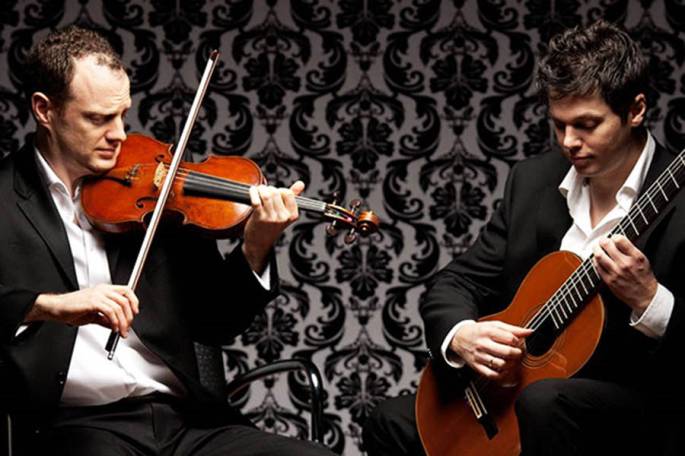
Violinist Jasper Wood and guitarist Daniel Bolshoy charmed the audience at the last concert of the North Okanagan Community Concert Association’s season on March 18th.
By Jim Leonard
Some well-played Chopin from Vernon pianist Alex MacArthur was a good start to NOCCA’s final concert of the season Saturday at the Vernon Performing Arts Centre.
The piece, Scherzo in B-flat, was played brilliantly by MacArthur, who recently joined the faculty at the Vernon Community Music School. He has also played with the Okanagan and Kamloops symphony orchestras as guest soloist.
Duo Rendezvous, with Jasper Wood on violin and Daniel Bolshoy on guitar, began their program with the Suite in E minor by J.S. Bach. The music was very intricate and at times I sensed a little uneasiness in the ensemble between the two players. This lasted for only a short time in this very demanding and complex work.
In the Suite Populaire Espagnole by Manuel de Falla (1876-1946) the duo showed their skills. There were various instrumental effects: harmonics produced by touching the string(s) lightly at strategic spots on the fingerboard and pizzicato on the violin, etc.
Wood’s violin tone was extraordinarily beautiful at all times. He proved himself to be a true master of the violin.
The last piece of the first half, Introduction and Tarentelle by violin virtuoso Pablo de Saraste (1844-1908), explored the outer limits of the violin’s range. It resorted to harmonics to go beyond the usual notes of the fingerboard. Wood’s intonation was always perfect as he played in the piece’s gypsy style.
Bolshoy was up to the task of keeping the rhythm constant while providing all the harmony on the six strings of his guitar – no mean feat indeed.
The second half of the concert began with Antonio Carlos Jobim’s Luiza. Jobim (1927-1994) was a Latin style composer/pianist famous for his bossa nova pieces. That’s not what we heard in Luiza. The piece was modern and emotional with complex harmonies and free rhythmic movement. Apparently Jobim had several love affairs throughout his life and Luiza is said to be one of them.
Histoire du Tango and Seasons of Buenos Aires by Italian composer Astor Piazzolla (1921-1992) had percussion effects added by both the violin and the guitar. Wood bowed his violin close to the bridge next to the chin rest, producing a raspy imitation of maracas. Bolshoy tapped on his guitar giving a bongo effect. Each piece represented scenes from various places in Latin America. In spite of the brilliant playing of these pieces, I must admit they were beginning to sound a little similar to each other.
Csardas by Vittorio Monti (1868-1922) was a refreshing antidote to the previous set of pieces, with its lively pace and virtuosic playing of the violin. The technique of both players was flawless and exciting to witness.
A brief whimsical encore called Cafe Espresso 1930 (I didn’t catch the composer) sent the enthusiastic audience home satisfied.
I would like to thank the NOCCA organization for a wonderful season of diverse and delightful entertainment.




 North Okanagan Community Concert Association